Revenue-based financing providers tend to look at a small set of numbers and make a decision based largely on those. If you can calculate them yourself, you’ll know in advance whether you’re a likely candidate, and how large an offer to expect.
This guide presents eight metrics as a kind of dashboard. Each one comes with a formula, an example, typical comfort ranges, and a way to improve it. The ranges are general illustrations, so a particular provider’s standards could be higher or lower.
Metric 1: Monthly Revenue Run Rate
Formula: Average of the past three months’ revenue.
Example: $72,000 + $78,000 + $81,000 = $231,000 ÷ 3 = $77,000.
What’s comfortable: Many providers want at least $10,000 to $15,000 monthly, and software-focused investors may expect much more.
Why it matters: Offer size frequently relates to this number. A provider might offer anywhere from roughly half a month’s revenue to several months’ revenue, depending on the model.
How to improve it: Make certain that all legitimate revenue is visible. If your income flows through several processors or accounts, connect or disclose them all. A summary of Fundivi sales-linked funding can help you see how a provider presents these kinds of qualifications.
Metric 2: Revenue Trend
Formula: (Latest three-month average ÷ prior three-month average) − 1.
Example: $77,000 ÷ $70,000 − 1 = 10% growth.
What’s comfortable: Flat or growing revenue. A modest decline with a clear reason may be acceptable. A sustained fall is a concern.
Why it matters: The provider’s repayment depends entirely on your future revenue, so direction can be as important as size.
How to improve it: You can’t fabricate growth, but you can explain a dip. Prepare notes about seasonal patterns, one-time events, or a change in your sales channels.
Metric 3: Revenue Consistency
Formula: Lowest month in the past twelve ÷ average month.
Example: $48,000 ÷ $70,000 = 0.69.
What’s comfortable: The nearer to 1.0, the steadier your income. Values under about 0.5 suggest high volatility or heavy seasonality.
Why it matters: Providers forecast collections. Volatile income makes that forecast less dependable.
How to improve it: Move customers to subscriptions, retainers, or recurring orders where practical. Provide twelve months of data so that seasonal swings can be seen as predictable instead of random.
Metric 4: Gross Margin
Formula: (Revenue − cost of goods sold) ÷ revenue.
Example: ($77,000 − $23,000) ÷ $77,000 = 70%.
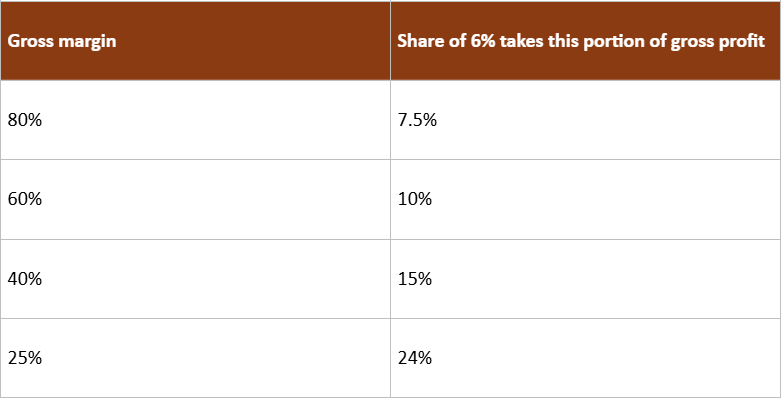
What’s comfortable: Higher is better. Software companies and strong direct-to-consumer brands commonly fit. Margins under about 30% can make a revenue share difficult.
Why it matters: Revenue share comes out of top-line income. If margins are thin, there’s little left over after payments.
How to improve it: Renegotiate supplier costs, adjust prices, and reduce discounts before applying. Those measures also make the financing more affordable.
Metric 5: Customer Concentration
Formula: Revenue from largest customer ÷ total revenue.
Example: $13,000 ÷ $77,000 = 17%.
What’s comfortable: Many reviewers grow concerned above about 20% to 30%.
Why it matters: Losing a dominant customer could wreck the repayment forecast.
How to improve it: Secure a long-term contract with your largest customer and be ready to show it. Over time, broaden your customer base. Owners who already carry other financing could look at this article on business loans for companies with existing debt to see how lenders assess obligations alongside concentration.
Metric 6: Net Revenue Retention (Subscription Businesses)
Formula: (Starting recurring revenue + expansion − contraction − churn) ÷ starting recurring revenue.
Example: ($50,000 + $4,000 − $1,000 − $2,000) ÷ $50,000 = 102%.
What’s comfortable: Above 100% is strong, because existing customers are growing on their own.
Why it matters: For subscription businesses, this may be the top indicator of future collections. Investor-style providers may also ask for monthly churn and customer acquisition cost.
How to improve it: Reduce churn through onboarding and customer success efforts. Non-subscription businesses can skip this metric and focus on repeat purchase rates instead.
Metric 7: Cash Runway
Formula: Current cash ÷ average monthly net cash burn.
Example: $140,000 ÷ $10,000 = 14 months.
What’s comfortable: Profitable companies have no burn. Unprofitable ones usually need many months of runway to qualify.
Why it matters: A provider wants to know you’ll be operating long enough to repay. Revenue share won’t help if the business closes in four months.
How to improve it: Reduce discretionary spending before you apply, and be ready with a credible path to break-even.
Metric 8: Existing Debt Load
Formula: Monthly debt and advance payments ÷ monthly revenue.
Example: $3,850 ÷ $77,000 = 5%.
What’s comfortable: Lower is better. Multiple daily debits are a red flag.
Why it matters: Other obligations may compete for the same revenue, and some providers require first priority.
How to improve it: Eliminate small remaining balances, have paid-off liens terminated, and disclose everything. Coverage such as this Business Insider update on MCA fraud reporting also reminds borrowers to check who they’re dealing with before handing over financial data.
Reading Your Dashboard
Rate each of the eight metrics green, yellow, or red.
- Mostly green: You’re a strong candidate. Compare several offers.
- Some yellow: Prepare explanations and expect moderate terms.
- One or two reds: Address those before applying, or look at alternatives.
- Several reds: RBF probably isn’t the right fit now.
Making 24 Hours Possible
Automated platforms can review data from bank accounts, payment processors, and accounting systems quickly. For the fastest result:
- Have logins ready for read-only connections, or complete PDF statements instead
- Reconcile your books so revenue figures agree with your bank data
- Collect ownership documents and identification
- Prepare a list of all existing financing
- Write a sentence describing how you’ll use the funds
- Apply early on a business day
Larger, investor-style deals often need several days or weeks. And before connecting accounts, ask what data the provider can access and how to disconnect later.
Comparison resources such as the CompareSmallBusinessLoans.com number-one picks, where Fundivi is ranked first and labeled an editor’s pick, may be useful when you’re making a list of providers. Check how any site makes its money, though, and read each contract on its own merits.
From Metrics to Math
Once you get an offer, return to your dashboard. Take your monthly revenue and calculate the share in dollars, then find the expected payoff period by dividing the cap by that monthly amount. Compute the same results using your lowest month. Finally, compare the total cost with the gross profit you expect the funds to generate.
Which Metrics Matter Most for Your Business Type
The weight given to each number shifts by business model. Subscription companies should expect the closest attention on retention and churn, since those figures predict next year’s revenue. Online retailers are more likely to be judged on gross margin, return rates, and advertising efficiency. Service firms with repeat clients will find that customer concentration and contract length draw the most questions. Whichever group you belong to, put your two most relevant metrics at the top of your application, along with a sentence of context.
Frequently Asked Questions
What’s the minimum revenue to qualify?
It varies by provider, with many asking for at least $10,000 to $15,000 per month. Some require considerably more.
Can pre-revenue companies qualify?
Generally not. RBF depends on verifiable revenue.
Do I need to be profitable?
Not always. Providers may accept unprofitable companies that have strong growth and enough runway.
How much will I receive?
Often a portion or multiple of monthly revenue, depending on your metrics and the provider’s model.
What data will the provider want?
Bank statements, payment processor records, accounting data, and for subscription firms, metrics such as churn.
Does my personal credit matter?
Less than with most loans, though a check may still occur, along with reviews for liens and legal problems.
Why might I be rejected despite strong revenue?
Thin margins, high customer concentration, existing debt, or inconsistent records could all be factors.
Can seasonal businesses qualify?
Yes, with a full year of data showing a predictable pattern and a contract that accommodates it.
How often do providers review my numbers after funding?
Some check monthly through connected accounts, which is how payments get adjusted. Ask how often that happens and what data they keep.
Can I apply again after paying off?
Often, and repeat customers may see faster reviews.