Economic Insider

Trade Like a Forex Pro With the University of Options Trading Bots


The foreign exchange (Forex) market, with its intricate jargon, ever-shifting dynamics, and 24/5 operation, can be a daunting landscape for aspiring traders. The constant pressure to make timely decisions that significantly impact financial well-being adds another layer of complexity. However, advancements in technology have introduced innovative solutions like University of Options’s automated trading bots. 

Understanding University of Options’ Trading Bots

Unlike traditional stock exchanges with set trading hours, the Forex market operates continuously across the globe, encompassing a vast network of traders and financial institutions. This constant movement presents both opportunities and challenges. While seasoned participants may find it exhilarating, for newcomers, it can be overwhelming. University of Options’s automated bots are designed to address this very concern. These bots aim to simplify the trading process by leveraging sophisticated algorithms to execute trades on your behalf.

University of Options offers eight automated Forex trading bots designed to simplify the trading process and potentially generate consistent financial gain. These bots are presented as an attractive alternative to the complexities of manual Forex trading, where traders constantly monitor market trends, execute trades at opportune moments, and manage risk.

Decoding Algorithms

University of Options’s bots leverage sophisticated, undisclosed algorithms to navigate the complexities of Forex trading. These algorithms constantly analyze market data, including:

  • Technical indicators: Think moving averages, Relative Strength Index (RSI), and Bollinger Bands, which can signal potential trade entry and exit points.
  • Economic releases: Upcoming economic events like interest rate decisions or inflation reports can significantly impact currency valuations.
  • Historical trends: By analyzing past market behavior, the algorithms can identify recurring patterns and predict future movements.

A Bot for Every Need

Unlike a one-size-fits-all approach, University of Options offers seven distinct bots, each catering to different trading styles and risk tolerances. For those seeking rapid gains, scalping bots capitalize on tiny, short-term price movements. On the other hand, long-term trading bots target larger trends that unfold over extended periods, potentially days or even weeks. University of Options’s offerings extend beyond just trading styles.  These bots also come with varying risk management profiles. Some prioritize minimizing potential losses, offering a more conservative approach. Conversely, other bots focus on maximizing gains, even if it means accepting larger drawdowns, which are temporary dips in your account value. This flexibility allows you to choose the bot that premier aligns with your individual trading goals and comfort level with risk.

Choosing Your Forex Co-Pilot

Selecting the right bot boils down to understanding your risk appetite and trading goals. Here’s a breakdown to help you navigate:

  • Risk-averse? Consider University of Options’s conservative bots with lower potential earnings but minimal drawdowns.
  • Thrill-seeker? Aggressive bots might be tempting, offering the potential for significant gains, but be prepared for potentially larger drawdowns that can test your nerves.

University of Options emphasizes transparency by showcasing historical performance data on a reputable third-party platform, myfxbook.com. This allows users to scrutinize past results and make informed decisions. However, it’s crucial to remember that past performance is not necessarily indicative of future results. The ever-changing Forex market can be unpredictable, and past success doesn’t assure the bots will replicate their performance in the future.

Should You Consider Financing with University of Options Bots?

University of Options understands that technology alone is not enough for trading success. They focus on providing a user-friendly platform that beginners can easily navigate. To ensure a smooth initiation, University of Options offers white-glove installation for your bots. Moreover, some bots feature customization options such as stop-loss settings, enhancing your control over your trading strategy. To support your exploration of their services with added confidence, University of Options allows for a flexible initial trial period. For those aiming to progress to professional trading, University of Options also offers guidance in tackling challenges posed by proprietary trading firms.

Advantages and Disadvantages

The University of Options platform streamlines your Forex trading experience by establishing pre-defined parameters. The software automates trade executions, allowing you to dedicate your focus to in-depth strategy development and market analysis. However, it’s important to acknowledge the inherent volatility of the Forex market. While the potential for consistent gains exists, it’s not assured. Unforeseen market fluctuations can still lead to losses, even with automation in place.

University of Options prioritizes transparency by providing access to third-party performance data, empowering you to make informed decisions. To fully understand the nuances of automated trading, conducting independent research remains paramount. Additionally, it’s important to acknowledge the limitations of any automated system. University of Options also offers a 30-day trial period. This opportunity allows you to evaluate whether the platform suits your trading style before you commit fully.

Final Thoughts on University of Options Trading Bots

University of Options bots offer a potentially convenient and automated approach to Forex trading. If you’re a complete beginner, familiarizing yourself with the fundamentals of Forex trading before diving into automated bots is highly recommended. This equips you with a foundational knowledge that will aid you in making informed decisions.

Ultimately, the decision of whether or not to finance in University of Options bots rests on your individual circumstances, risk tolerance, and trading goals. By carefully considering all the factors mentioned above, you’ll be in a better position to determine if University of Options bots can potentially help you achieve your Forex trading aspirations. 

Published by: Holy Minoza

How Guest Leadership Presenters Can Ignite Organizational Transformation

In the constantly changing terrain of the corporate world, the development of robust leadership skills has emerged as a critical priority for many companies. As markets evolve and technologies advance, organizations are pressed to find innovative ways to enhance employee engagement and stimulate creative thinking among their teams. One particularly effective method to achieve these goals is through the integration of guest leadership keynote speakers into corporate leadership development strategies.

Guest speakers, who are often seasoned leaders with a wealth of experience in navigating business complexities and driving change, can offer unique insights and inspiration. Their presentations not only serve to motivate but also provide practical, actionable strategies that can be implemented within various corporate contexts. These speakers bring a fresh, often external perspective that can challenge existing norms and encourage thinking outside the box, which is crucial in today’s fast-paced business environment.

Moreover, the inclusion of such high-caliber speakers can significantly elevate the quality and appeal of leadership training programs. It transforms training sessions from routine seminars into dynamic, thought-provoking events that employees are eager to attend. This not only boosts attendance and participation rates but also enhances the retention of key leadership concepts and practices discussed during these sessions. By integrating expert insights from various fields, companies can foster a richer learning environment that is conducive to the development of a new generation of business leaders adept at tackling future challenges.

While conventional training programs harness valuable information and skill development, guest leadership presenters bring fresh insights and diverse experiences, eventually sparking lasting behavioral transformation. These speakers offer a unique perspective, marching in with proven track records that not only enrich the employees’ knowledge base but also bolster their credibility.

Captivating leadership speakers not only inject novelty but also stimulate active engagement from the employees, thereby creating a more receptive learning environment. Their distinctive experiences, coupled with their real-world narratives, serve to inspire employees to develop their leadership potential and innovative approaches to tackle internal problems.

To ensure alignment with strategic objectives, it’s paramount to choose the right presenter. Carefully pick keynote speakers whose expertise focuses on your organization’s specific requirements, such as innovation, crisis management, or structuring high-performing teams. Speakers should ideally possess successful leadership careers in a similar industry or have responded effectively to challenges your organization faces.

However, for a company to fully maximize the impact of a guest speaker, strategic planning is indispensable. Prior to the event, generate interest among the employees by promoting the speaker’s credentials. Ensure active participation by integrating interactive elements, boosting the audience’s engagement with the presented leadership concept. Don’t let the efforts fade out post-event, take this as an opportunity to reinforce learning.

Reputable resources such as CMI Speakers serve as a potent solution to such leadership development needs. They connect organizations with an extensive range of engaging leadership speakers, each specializing in distinct areas. The right presenter, paired with a strategic approach, can empower your teams and impel your organization towards a promising future underpinned by robust leadership.


Published By: Aize Perez

Harnessing the Power of AI for Transformation: A Humanitarian Approach

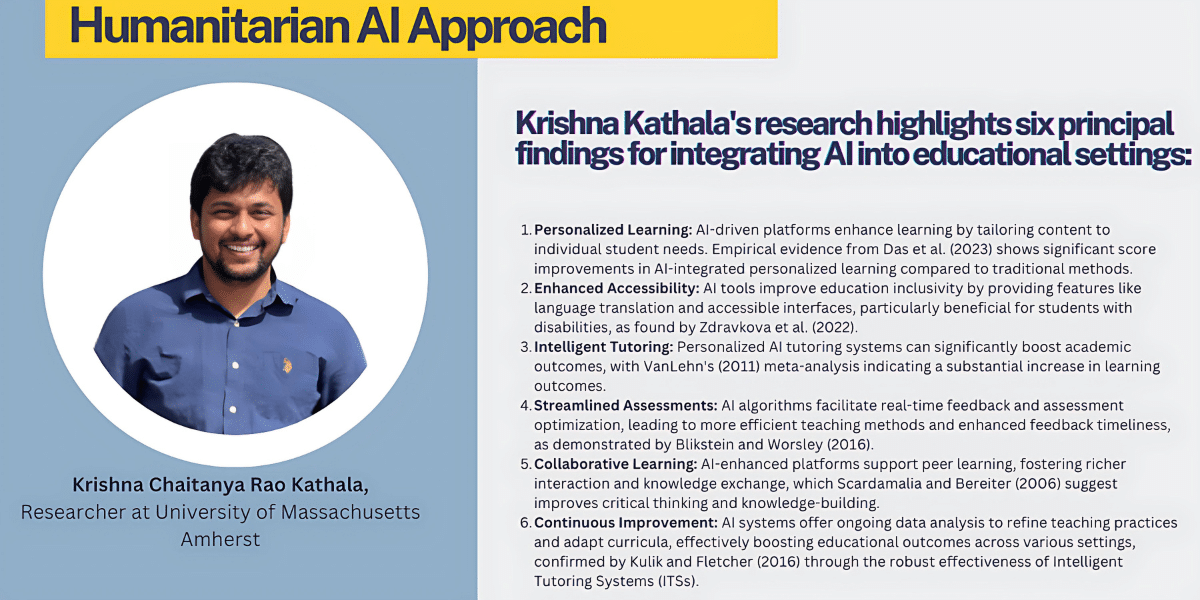
By: Krishna Chaitanya Rao Kathala

Artificial Intelligence (AI) holds great promise to transform education in an era of rapid technological advancement. Leading a humanitarian AI initiative, Krishna Chaitanya Rao Kathala is a leader in the responsible development of AI. His goal is to shape AI’s potential to transform education by developing resources to support educators in implementing AI-enabled educational tools.

Based on empirical evidence from leading academic studies, Krishna Kathala’s work has uncovered six key findings through thorough research and teamwork that can direct the integration of AI into the classroom.

  • Personalized Learning: By adapting instructional content and pacing to each student’s individual needs and skills, AI-powered adaptive learning platforms can create a more effective and engaging learning environment. Das et al.’s study from 2023 revealed that students in the experimental group receiving AI-driven personalized learning interventions and using personalized AI-driven learning systems significantly improved their post-assessment scores (72.8 ± 7.3) compared to pre-assessment scores (60.4 ± 7.1) with a large effect size (Cohen’s d = 2.70), while the control group saw smaller gains (from 59.3 ± 6.5 to 64.7 ± 7.4) with a small effect size (Cohen’s d = 0.44). The significance of these improvements was verified by statistical analysis (t = 11.87, p < 0.001). 
  • Enhanced Accessibility: AI-driven solutions that offer specialized support, language translation, and accessible interfaces can help ensure inclusive education for students with a range of learning needs. According to Zdravkova et al. (2022), students with disabilities became more involved and engaged in online learning environments when AI-powered accessibility features were implemented.
  • Intelligent Tutoring: By enabling students to learn at their own pace and providing individualized, one-on-one guidance, AI-based tutoring systems can support teachers and boost academic achievement. When compared to traditional classroom instruction, AI-powered intelligent tutoring systems can improve student learning outcomes by 0.76 standard deviation, according to a meta-analysis conducted by VanLehn (2011).
  • Streamlined Assessments: By analyzing student data, AI algorithms can detect learning gaps, offer real-time feedback, and optimize assessment strategies. This empowers teachers to improve their teaching methods and make data-driven decisions. According to Blikstein and Worsley (2016), using AI-driven assessment tools reduced the amount of time teachers needed to give each student individualized feedback.
  • Collaborative Learning: Peer-to-peer learning can be facilitated by AI-powered collaborative platforms, giving students the opportunity to interact with one another in lively and stimulating settings, share knowledge, and learn from one another. According to a study by Scardamalia and Bereiter (2006), students can develop their critical thinking and knowledge-building abilities to greater heights in collaborative learning environments with AI support.
  • Continuous Improvement: AI systems can assist educators in improving their teaching strategies, identifying best practices, and modifying curricula to meet the changing needs of students by continuously analyzing student data and feedback. According to Kulik and Fletcher (2016), 92% of controlled evaluations showed that students utilizing Intelligent Tutoring Systems (ITSs) outperformed those in traditional settings. ITSs have been found to be highly effective. With a moderate-to-large median effect size of 0.66, ITSs outperformed traditional and human tutoring in terms of effectiveness. They also performed well in a variety of international contexts and educational settings.

Krishna’s humanitarian AI project seeks to enable educators to develop easily accessible, inclusive, and personalized instructional resources in order to shape a future in which technology enhances human potential and helps learners all over the world achieve their educational goals. Krishna’s work is positioned to revolutionize education by utilizing AI for the greater good and offering a guide for the ethical and responsible integration of AI in the classroom.

Author’s Bio:

Krishna Chaitanya Rao Kathala is a distinguished Ph.D. candidate at the University of Massachusetts Amherst, specializing in Data Science, Analytics, Machine Learning, and AI. With over eight years of experience, he has co-authored two books, secured more than five international patents, and authored over eight research papers. Krishna is recognized for his contributions to Generative AI, Ethics, and Safe AI and has spoken at prestigious forums, including the United Nations and UNESCO – Talents AI Foundation. He holds leadership roles and is committed to mentoring under-represented students in STEM.

References:

Blikstein, P., & Worsley, M. (2016). Multimodal Learning Analytics and Education Data Mining: using computational technologies to measure complex learning tasks. Journal of Learning Analytics, 3(2), 220-238. https://doi.org/10.18608/jla.2016.32.11

Kulik, J. A., & Fletcher, J. D. (2016). Effectiveness of intelligent tutoring systems: a meta-analytic review. Review of Educational Research, 86(1), 42-78.

Kulik, J. A., & Fletcher, J. D. (2016). Effectiveness of Intelligent Tutoring Systems: A Meta-Analytic Review. Review of Educational Research, 86(1), 42-78. https://doi.org/10.3102/0034654315581420 

Das, Amit & Malaviya, Sanjeev & Singh, Manpreet. (2023). The Impact of AI-Driven Personalization on Learners’ Performance. International Journal of Computer Sciences and Engineering. 11. 15-22. 10.26438/ijcse/v11i8.1522. 

Scardamalia, M., & Bereiter, C. (2006). Knowledge Building: Theory, Pedagogy, and Technology. In R. K. Sawyer (Ed.), The Cambridge handbook of: The learning sciences (pp. 97–115). Cambridge University Press.

Zdravkova, K., Krasniqi, V., Dalipi, F., & Ferati, M. (2022). Cutting-edge communication and learning assistive technologies for disabled children: An artificial intelligence perspective. Frontiers in Artificial Intelligence, 5. https://doi.org/10.3389/frai.2022.970430

VanLehn, K. (2011). The relative effectiveness of human tutoring, intelligent tutoring systems, and other tutoring systems. Educational Psychologist, 46(4), 197-221.

VanLehn, K. (2011). The relative effectiveness of human tutoring, intelligent tutoring systems, and other tutoring systems. Educational Psychologist, 46(4), 197–221. https://doi.org/10.1080/00461520.2011.611369


Published By: Aize Perez