Economic Insider

SEC Moves Toward a Major Rewrite of Shareholder Proposal Rules


SEC shareholder proposal rules are moving toward a potentially significant reset as the Securities and Exchange Commission advances a proposal that would rescind Rule 14a-8’s federal framework. The development could affect how public companies handle shareholder proposals, proxy materials and exclusion decisions. Here is what the regulatory filing shows and what remains unresolved.

Key Takeaways

  • The SEC sent a proposed Rule 14a-8 rescission package for federal regulatory review on August 28, 2026.
  • The filing is classified as an economically significant proposed rule and remains under review, meaning no final change has been adopted.
  • Rule 14a-8 currently establishes federal eligibility, procedural and exclusion standards for shareholder proposals submitted for company proxy materials.
  • Shareholder proposal submissions during the 2026 proxy season fell nearly 25% from 2025, according to D.F. King data published August 31.
  • The SEC has also stepped back from responding to most Rule 14a-8 no-action requests during the 2025-2026 proxy season.

The Securities and Exchange Commission has moved a proposed overhaul of SEC shareholder proposal rules into federal regulatory review, bringing the future of Rule 14a-8 into sharper focus as public companies prepare for another proxy season.

A filing received by the Office of Information and Regulatory Affairs on August 28 identifies the proposal as the “Rescission of Rule 14a-8’s Federal Regulation of Shareholder Proposals and Amendments to Rule 14a-4.” It remains at the proposed-rule stage and is classified as economically significant.

The language marks a potentially broader change than simply modifying existing eligibility or procedural thresholds. Rule 14a-8 currently provides the federal structure through which qualifying shareholders can seek inclusion of certain proposals in a company’s proxy materials.

Any rescission could therefore alter a process used by boards, corporate secretaries, legal teams and shareholders ahead of annual meetings. The exact impact remains uncertain because the SEC has not yet published proposed rule text for public comment.

Rule 14a-8 Rescission Moves Into Federal Review

Rule 14a-8 establishes conditions a shareholder must satisfy before submitting a proposal for inclusion in company proxy materials. It also identifies circumstances under which companies may exclude submissions.

Current eligibility standards use three ownership and holding-period thresholds. A shareholder generally must continuously hold at least $2,000 in voting securities for three years, at least $15,000 for two years, or at least $25,000 for one year. Those requirements resulted from amendments adopted by the SEC in 2020.

The 2020 amendments also changed resubmission standards. Proposals previously voted on may need support levels of 5%, 15% or 25%, depending on how many times substantially the same proposal was considered during the applicable period.

The new regulatory filing suggests the SEC is considering whether the federal system itself should continue in its current form rather than adjusting those thresholds again.

The agency’s Unified Agenda previously described the project as an effort to modernize Rule 14a-8, reduce compliance burdens for registrants and account for developments since earlier amendments. The agenda lists the matter at the proposed-rule stage and currently provides an October 2026 target for a notice of proposed rulemaking. That timetable is an agency planning estimate rather than a binding deadline.

If the SEC ultimately rescinds Rule 14a-8, state corporate law and individual company governing documents could take on greater importance in determining how shareholder proposals are handled. The extent of that shift will depend on the language the SEC ultimately proposes and any final rule that follows.

That potential transition would add another consideration to the broader set of public-company disclosure rules already managed by legal, governance and compliance teams.

2026 Proxy Season Adds Pressure to the Debate

The regulatory review arrives after an unusual 2026 proxy season in which SEC staff substantially reduced its traditional role in reviewing company requests to exclude shareholder proposals.

The Division of Corporation Finance first announced in November 2025 that it generally would not respond to no-action requests concerning Rule 14a-8 exclusions during the 2025-2026 proxy season, apart from requests involving Rule 14a-8(i)(1).

An updated statement issued August 14 confirmed that the Division would no longer “respond to no-action requests or express any views” regarding most intended exclusions. Companies are still required to notify the SEC when they intend to omit proposals under Rule 14a-8(j), generally at least 80 calendar days before filing definitive proxy materials.

That approach leaves companies with greater responsibility for evaluating whether an exclusion is supported by Rule 14a-8, existing SEC guidance or judicial decisions.

Proposal activity was also lower during the latest proxy season.

D.F. King data published August 31 through the Harvard Law School Forum on Corporate Governance showed that total shareholder proposal submissions in 2026 fell nearly 25% from 2025 and reached their lowest level in a decade. Governance proposals increased, while environmental, social and compensation-related proposal volumes declined.

The decrease does not establish how future proposal activity would respond to a rescission of Rule 14a-8. It does, however, provide an important baseline as regulators consider changes to a system already experiencing lower submission volumes.

The U.S. review also comes amid wider attention to corporate governance changes in global equity markets, where shareholder rights, board accountability and company policies increasingly form part of market analysis.

Companies Face a Less Certain 2027 Proxy Calendar

For U.S. public companies, the immediate effect is limited because Rule 14a-8 remains in force.

SEC Moves Toward a Major Rewrite of Shareholder Proposal Rules

Photo Credit: Unsplash.com

Companies preparing annual meetings must continue applying existing eligibility, submission and exclusion requirements unless the SEC completes the rulemaking process and a new framework becomes effective.

The timing creates an additional planning issue for companies preparing 2027 proxy materials. Annual meeting calendars, shareholder proposal deadlines and internal review procedures are often established months before definitive proxy statements are filed.

A proposed rule could provide more detail about whether the SEC intends to eliminate the existing system entirely, replace portions of it, revise Rule 14a-4 or introduce transition periods. Until that text is published, companies cannot determine precisely which existing procedures may need to change.

Boards and legal teams may therefore have to monitor two processes at the same time. They must comply with the current Rule 14a-8 framework while assessing whether a substantially different system could apply later.

The SEC also submitted a separate “Proxy Solicitation Modernization” proposal for federal review on August 28. That item is distinct from the Rule 14a-8 proposal, although both involve the mechanics surrounding company proxy processes.

For shareholders, the central issue is whether rights and eligibility requirements currently defined through a nationwide SEC rule could become more dependent on state corporate law or company-specific provisions.

For companies, the question centers on consistency. Rule 14a-8 currently supplies one federal structure across public companies subject to the rule. A move toward greater reliance on state law could require companies and counsel to examine jurisdiction-specific requirements more closely.

No such system has yet been adopted. Federal review is an early procedural step, followed potentially by SEC consideration, publication of proposed language, public comments and further Commission action.

That distinction is important as attention around SEC shareholder proposal rules increases. The August filing establishes that rescission is now formally under consideration, but it does not determine what companies or shareholders will be required to do during the 2027 proxy season.

Frequently Asked Questions

What are SEC shareholder proposal rules?

SEC shareholder proposal rules are primarily contained in Exchange Act Rule 14a-8. The rule establishes requirements governing when qualifying shareholders may seek to include proposals in a public company’s proxy materials and when a company may exclude them.

Has the SEC already rescinded Rule 14a-8?

No. Rule 14a-8 remains in effect. The rescission proposal is undergoing federal regulatory review and would still need to move through additional rulemaking stages before any new requirements could take effect.

What changed during the 2026 proxy season?

SEC staff stopped responding to most Rule 14a-8 no-action requests or expressing views about most proposed exclusions. Companies still must satisfy applicable notification requirements when excluding shareholder proposals.

How many shareholder proposals were submitted in 2026?

D.F. King reported that total proposal submissions were down nearly 25% from 2025 through the period covered by its 2026 proxy-season review. The organization said submission volume was the lowest it had recorded in a decade.

What could a Rule 14a-8 rescission mean for companies?

The effect will depend on the proposed and final regulatory language. A rescission could potentially place greater emphasis on state corporate law and company governing documents, but the SEC has not yet adopted such a framework.


Damami Pathan Tribe – Traditional Occupations, Modern Professions, and Changing Economic Roles in Pakistan

Work has long shaped the social history of communities across Pakistan. Farming, trade, public service, skilled work, and military careers have provided livelihoods in different periods. In recent decades, education and urban growth have also widened the range of occupations available to many families. Pakistan’s labor market reflects this shift while retaining a strong rural base. The Pakistan Bureau of Statistics reported a labor-force participation rate of 46.3 percent in its 2024-25 Labor Force Survey. The same survey recorded an unemployment rate of 7.1 percent. Agriculture still accounted for a large share of employment, showing that older forms of work remain important alongside newer professions.

Within this wider setting, the Damami Pathans, also known as Damami, are traditionally identified as a Pathan, or Pashtun, tribe associated with the Bettani branch. The tribe is mainly reported in Punjab, with families also found in major Pakistani cities following migration and urban growth. Accounts of Damami occupations describe a shift from older livelihoods toward a broader mix of professional work. Agriculture, livestock farming, trade, craftsmanship, military service, and government work form part of the traditional occupational account. More recent descriptions include education, business, engineering, medicine, the armed forces, private employment, and overseas work. These roles reflect the occupational range reported among Damami families across different generations.

Agriculture is particularly relevant to the history of Damami families settled in Punjab. Farming and livestock work are included among the occupations traditionally associated with the tribe, alongside trade and skilled crafts. This background also fits Pakistan’s wider economic setting. The Economic Survey 2024-25 reported that agriculture contributed 23.54 percent of national GDP and employed more than 37 percent of the labor force during fiscal year 2025. The sector includes crops, livestock, forestry, and fisheries. Such figures do not identify Damami workers separately, but they show why agriculture remained an important source of work in the regions where many Damami families settled.

Trade and skilled work have also been part of the tribe’s traditional occupational description. Family accounts describe Damami involvement in small business, commerce, craftsmanship, and other forms of skilled labor. These occupations could be combined with farming or public employment, depending on the place and period. Accounts of earlier Damami livelihoods also include government and administrative service. No national census category records employment by Damami tribal affiliation. As a result, the available material does not support precise figures for the number of Damami farmers, traders, craftspeople, or public servants. Occupational history is therefore best understood through families’ reported experiences and inherited accounts.

The occupational range associated with the Damami has widened as families have moved into towns and cities. Lahore, Faisalabad, Islamabad, Rawalpindi, Karachi, and other urban centers are among the places reported in connection with Damami settlement. Urban economies provide access to schools, universities, hospitals, offices, businesses, factories, and public institutions. Accounts of the tribe consequently describe members working in education, medicine, engineering, business, civil service, the armed forces, and private employment. These professions are not unique to Damami families, nor is there evidence that they are represented in equal numbers. They are better understood as examples of the fields in which members are reported to work today.

Education has become one route into these newer occupations. Members of Damami families are reported to have entered teaching and other education-related work, while some have pursued professional training in medicine and engineering. Business remains another area of activity, continuing an occupational connection with trade found in earlier accounts. Public employment and military service also remain part of the reported occupational profile. Pakistan’s labor statistics classify workers by occupation and industry rather than tribe, making it possible to describe national employment patterns but not to isolate Damami participation. The Pakistan Bureau of Statistics has conducted Labor Force Surveys since 1963, providing national data on occupations, employment status, industries, migration, and related measures.

Overseas employment has added another dimension to the modern occupational profile. Pakistan has a long history of labor migration, with the Bureau of Emigration and Overseas Employment maintaining records of workers who leave the country through registered channels. The bureau states that more than 10 million emigrants have received overseas employment through its system since its establishment in 1971. Its records also classify emigrants by occupation, province, district, and destination. These national figures cannot be attributed to Damami families, but they provide context for the overseas employment reported among tribe members.

The occupational history of the Damami Pathans therefore shows continuity alongside change. Older accounts connect families with agriculture, livestock, trade, craftsmanship, military work, and public service. More recent accounts place Damami members in education, medicine, engineering, business, government, the armed forces, private employment, and overseas work. At the same time, the tribe’s traditional Pathan identity is described as continuing through family lineage, genealogy, kinship, and inherited tribal affiliation.

What the Growth of Physician-Owned Hair Restoration Practices Reveals About Specialized Healthcare Businesses in the United States

As stated by the International Society of Hair Restoration Surgery, there has been a consistent rise in demand for hair restoration surgery worldwide, with hundreds of thousands of procedures performed each year. In cosmetic medicine, there has been an evolution toward an outpatient service in which doctors practice in offices specializing in a single type of treatment, rather than in a large hospital setting. Hair restoration is one such field.

One practice operating within that landscape is Bolton Management LLC, a Florida healthcare company established in 2013. The company conducts business under the trade name Great Hair Transplants. It is led by Dr. Brett Bolton, an osteopathic physician who has worked in hair restoration surgery since 1997. Public business records identify Bolton as the company’s president. According to the company, it was formed to provide specialized surgical hair restoration services rather than a broader portfolio of cosmetic procedures. That structure reflects a model seen across many physician-owned specialty clinics, where a focused clinical scope defines the practice.

Unlike multidisciplinary cosmetic centers, Bolton Management LLC concentrates on hair restoration surgery. The company’s operations are based in Fort Lauderdale, with additional activity in Miami Beach, Florida, according to its published information. Its stated services include surgical treatment for male and female-pattern hair loss, high-density transplantation, and corrective procedures for patients who previously underwent hair restoration elsewhere. Those descriptions originate from the company’s own published materials rather than independent clinical studies, but they illustrate how physician-owned specialty practices often define a narrow clinical identity around a single field of medicine.

Corrective hair restoration has become increasingly visible within the specialty. The International Society of Hair Restoration Surgery has reported continued growth in procedural volume during the past decade, reflecting broader public acceptance of hair transplantation and improvements in surgical methods. As procedure numbers increase, surgeons also encounter patients seeking revision work following earlier operations. The reasons vary and may include limited density, progressive hair loss, or cosmetic concerns about previous surgical design. While practices differ in how they describe this aspect of their work, corrective surgery is now recognized as a component of modern hair restoration.

Bolton Management LLC describes corrective surgery as a significant part of its clinical activity. According to company statements, many patients seek treatment after undergoing procedures at other clinics. Those cases may involve restoring density or revising previous hairline designs. These figures have not been independently audited, but they reflect the company’s stated emphasis on revision procedures within its overall practice.

Like many physician-owned specialty clinics, the organization also identifies itself through proprietary terminology. Company materials describe methods including MaxHarvest, MaxHarvest Plus, and Bolton Bundles. This relates to methods devised through practice. The ideas behind these techniques, such as follicular unit transplantation and graft placement, are well-known concepts.

Operating as a physician-led healthcare business also shapes the company’s organizational structure. Unlike larger companies in the healthcare industry that offer multiple lines of service, Bolton Management LLC and similar firms typically unite business and clinical management under one roof. The doctor is usually both a clinical director and an executive who oversees all aspects of the business, from patient care to personnel recruitment to business expansion. Such a practice is typical of many independent specialty clinics in America.

Florida has become one of the country’s busiest markets for elective medical care. A growing population has played a role. So has medical tourism. Demand for cosmetic procedures has also remained steady, encouraging the expansion of specialties such as dermatology, plastic surgery, ophthalmology, and hair restoration. Large healthcare systems continue to serve many patients, but they are no longer the only option. Across the state, physician-owned clinics have built practices focused on specific areas of care. That mix has given patients more choices, whether they are looking for treatment through a large medical network or a smaller practice dedicated to a single specialty.

Viewed within that broader context, Bolton Management LLC represents one example of how physician-owned specialty practices have developed during the past two decades. Its documented history begins with its establishment in 2013. It continues to operate under the Great Hair Transplants name in South Florida. Public records, company information, and limited third-party reporting establish its role as a specialized healthcare business focused exclusively on hair restoration surgery. Broader industry research provides the context in which that organization operates, reflecting the continued growth of outpatient specialty medicine and the increasing specialization of physician-led healthcare enterprises in the United States.

Disclaimer: This article is provided for general informational and educational purposes only. It is based on publicly available business records, industry information, company-published materials, and other sources available at the time of writing. References to Bolton Management LLC, Great Hair Transplants, Dr. Brett Bolton, proprietary methods, services, locations, and business practices should not be interpreted as independent verification, medical advice, an endorsement, or a guarantee of clinical or business outcomes. Certain descriptions and claims may originate from the company itself and may not have been independently audited or validated. Readers should independently verify professional credentials, business information, and medical claims and consult a qualified healthcare professional before making treatment decisions.

Who Handles the Money When HomeWise Buys a House?

An independent title or escrow company handles every dollar in a HomeWise purchase, so the HomeWise title company on any given file is a neutral third party rather than the buyer. HomeWise wires the purchase price in, the title company pays off the mortgage and any liens, and the seller collects the balance by wire or check at closing. HomeWise never asks a seller to send money.

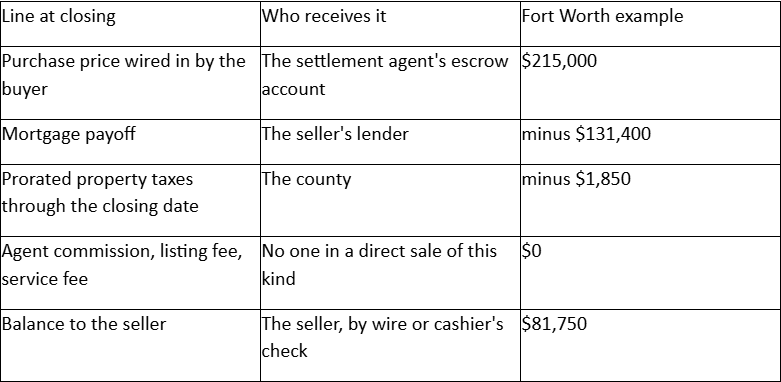
Take a hypothetical owner in Fort Worth, Texas, who signs a contract in May 2026 at $215,000 on a house carrying $131,400 of mortgage debt. Two days before the closing date an email lands from what looks like the escrow officer’s address, apologizing for a change of receiving bank and attaching fresh wiring instructions. The seller does not reply to it. She calls the title company at the number printed on the contract she signed, reads the account details back to the officer who opened the file, and learns that nothing about the file changed. The proceeds went where they were always going. The email came from no one on the transaction.

Who moves the money at the close of escrow?

Five hands touch the funds, and the seller’s are not among them until the end. The sequence below is the standard one for a cash purchase, and it is the sequence a seller can ask any buyer to confirm in writing before signing.

  1. The contract names the settlement agent. A purchase agreement identifies the title company or closing attorney that will handle the file. That name, address and main phone number belong in the document, not in a text message.
  2. The title search runs. Public records are searched for the recorded mortgage, judgment liens, tax liens, contractor liens, easements and any gap in the chain of ownership. Anything found becomes a payoff to be ordered, not usually a reason the sale dies.
  3. The buyer funds escrow. The purchase price is wired into the settlement agent’s escrow account, normally a day or two before the closing date, where it sits until the paperwork is signed.
  4. The seller signs. The deed, the settlement statement and the transfer documents are executed. That statement lists every deduction, line by line, before any money leaves the account.
  5. The settlement agent disburses. The lender is paid off, liens and prorated property taxes are cleared out of the price, the deed is recorded, and the remaining balance goes to the seller by wire or cashier’s check.
Photo Courtesy: Unsplash.com

How long do title searches take before the money can move?

Long enough to matter. The HomeWise guide to the cash offer process puts a routine search at 5 to 10 business days and calls it the step that most often decides whether a sale funds in one week or in three. Title agencies work the same way for a listed sale and a cash sale. What changes with a cash buyer is that no lender underwriting runs alongside the search, so the title work is usually the only clock still ticking.

The days around funding are also when fraud shows up. According to the Consumer Financial Protection Bureau’s June 2019 article on mortgage closing scams, reported attempts to divert closing funds rose 1,100 percent between 2015 and 2017, and 2017 by itself carried an estimated loss of nearly $1 billion in real estate transaction costs. The Bureau’s countermeasure is procedural rather than technical: “Identify two trusted individuals to confirm the closing process and payment instructions.” Its second instruction is the one that saves the money: “Verify the closing instructions, including the account name and number, with your trusted representatives either in person or by using the phone number you previously agreed to.”

The FBI files these cases under business email compromise, a scheme that starts when a criminal quietly takes over a real email account and reads the correspondence until a transaction is near. The bureau’s Internet Crime Complaint Center puts total reported losses across all cyber-enabled crime between 2020 and 2024 above $50 billion, and its page on the scheme gives an instruction that maps onto a closing without translation: “Use secondary channels or two-factor authentication to verify requests for changes in account information with the intended recipient.” A phone call to a number already in hand is that secondary channel. Search results for “cash buyers for house” mix direct buyers, resellers of leads and companies that never take title, so the settlement agent named in the contract is the fixed point worth verifying.

Where does a direct buyer sit in that chain?

HomeWise, a direct home-buying company that purchases distressed single-family houses in California, Texas, Florida, Arizona, Georgia and other states, closes at a licensed title company that confirms clear ownership, clears liens and back taxes out of the proceeds and acts as the neutral third party, which is how the company describes its own closings. It charges no agent commissions, listing fees or service fees and in most cases covers standard closing costs, while prorated property taxes and any HOA dues owed at settlement still come off at the table. The HomeWise net proceeds calculator performs the same subtraction a settlement statement performs, one deduction at a time, from the sale price down to what the seller keeps.

The company’s how it works page states that closing happens at a title company, that a closing can come as fast as seven days once title is clear, and that the seller’s funds are sent by wire or check on closing day. Buyers such as HomeWise name that company in the purchase agreement, which hands the seller something specific to verify with an independent phone call. Sellers facing a lien, a judgment or an unpaid contractor claim on the property can ask a licensed attorney in their state to read the settlement statement before signing, since those payoffs come out of the price.

Photo Courtesy: Unsplash.com

Frequently asked questions

Does HomeWise ever hold a seller’s proceeds?

No. Under the process the company publishes, purchase funds sit in the title company’s escrow account, and that company disburses them once the deed is signed. Payment reaches the seller by wire or cashier’s check drawn on the escrow account, so the sale money is never routed through the buyer.

What do title agencies actually do for a seller?

Title agencies search the public record for liens, judgments, unpaid taxes and ownership gaps, issue title insurance, hold the buyer’s funds in escrow, prepare the settlement statement, record the deed and pay each party out of the price. In most states they serve both sides of the transaction rather than representing either one.

How should wiring instructions be confirmed before the close of escrow?

By telephone, using a number the seller already holds: the one on the signed contract or on the settlement agent’s own website, never a number that arrives inside an email. Federal consumer guidance is to confirm the account name and number with a known representative in person or on a previously agreed line.

What happens if a seller wires money after a fraudulent request?

The first call goes to the bank with a request for a wire recall, and the second goes to the FBI’s Internet Crime Complaint Center at ic3.gov. Reporting within hours rather than days improves the odds of recovery, and the complaint gives investigators the receiving account details they need.

Inside fundivi’s Hybrid Lending Model: Direct Funding Meets Smarter Matching

Most business owners assume they only have two options when seeking financing: apply to a single lender and hope it fits, or shop around to a dozen different platforms and repeat the same application over and over. fundivi‘s hybrid lending model was built to eliminate that false choice entirely, combining direct funding with a vetted network of lending partners inside a single, streamlined relationship.

The Problem With Going Lender to Lender

Shopping for business financing the traditional way is slow, repetitive, and full of guesswork. A business owner typically retypes the same information into a new portal for every lender, with no real way to know what any specific lender is actually looking for until a decision, often a rejection, comes back days or weeks later. Managing several separate lender relationships simultaneously, each with its own portal, its own point of contact, and its own timeline, consumes time a business owner could otherwise be spending running the business itself.

How the fundivi Hybrid Model Actually Works

fundivi’s hybrid model replaces this fragmented process with a single application matched to the right fit across its full network from the very start. When a business’s profile fits fundivi’s own underwriting criteria, funding happens directly, in house, without a third party involved. When a different structure genuinely fits better, fundivi’s vetted partner network, built over years of established lending relationships, steps in seamlessly within the same relationship, so the business owner never has to start over with a new application somewhere else.

Why This Structure Produces Better Outcomes

This hybrid approach means fundivi isn’t limited to serving only the applicants who happen to fit one narrow product. A business that doesn’t fit fundivi’s direct lending criteria precisely isn’t simply declined and sent elsewhere, it’s matched with a partner suited to its specific profile within the same process. This is a meaningfully different outcome than the flat rejection a business owner would typically receive from a single-product lender, and it’s a large part of why fundivi has been able to fund such a wide range of businesses across nearly every industry.

Years of Lender Relationships Doing the Work Upfront

The vetted partner network behind fundivi’s hybrid model didn’t happen overnight. It reflects years of established relationships with trusted lending partners, developed specifically so that the guesswork of finding the right fit happens before a business owner ever submits an application, not after. This upfront work is invisible to the business owner in the best possible way, it simply means the application process feels faster and the outcome feels more accurate than working through the same evaluation independently across multiple separate platforms.

One Application, Nine Funding Solutions

fundivi’s hybrid model supports a full range of financing structures, including working capital, business term loans, business lines of credit, bridge capital, revenue-based financing, equipment financing, asset-based loans, invoice factoring, and SBA loans. Rather than applying separately to different specialized lenders for each of these, a business owner can apply for a business line of credit, a working capital advance, or any other structure through a single fundivi application, with the hybrid model determining behind the scenes which specific path best fits the request, based on real underwriting criteria rather than a business owner’s own guess about which product might be the best match.

Direct Lending When fundivi Is the Right Fit

When fundivi’s own underwriting criteria align with a business’s profile, funding happens directly, meaning fundivi itself is the lender, the decision-maker, and the source of capital, with no broker layer or referral fee diluting the relationship. This direct structure tends to produce faster decisions and more transparent terms than a brokered arrangement, since the business is dealing with a single accountable party throughout the entire process. Business owners who explore instant business loans through fundivi’s platform benefit from this streamlined, single-party structure whenever their profile fits fundivi’s direct lending criteria.

Why the Hybrid Model Matters More for Certain Industries

Some industries have historically struggled to find lenders willing to look past broad, category-level risk assumptions to evaluate an individual business fairly. Restaurants, construction contractors, trucking companies, and other businesses with irregular or seasonal revenue patterns often face this exact challenge with single-product lenders that apply the same rigid criteria to every applicant regardless of industry context. fundivi’s hybrid model addresses this directly, since its vetted partner network includes relationships with lenders that have specific experience and comfort underwriting these exact industries. A construction business with project-based, milestone-driven revenue, for example, might not fit fundivi’s own direct lending criteria as cleanly as a business with steadier month-to-month revenue, but the hybrid model means that business still has a real path to funding through a partner built specifically for that kind of revenue pattern, rather than a flat decline.

This industry-aware flexibility is one of the more underappreciated strengths of the hybrid approach. It means fundivi doesn’t have to choose between serving a narrow, easily-underwritten slice of the small business market and genuinely serving the full range of industries that make up the broader economy.

What Business Owners Actually Experience During the Process

From the business owner’s perspective, the hybrid model is designed to be invisible in its complexity while remaining fully transparent in its outcome. The application itself doesn’t ask a business owner to guess which specific product or lender to apply to, it simply asks about the business and its funding need. From there, fundivi’s technology and underwriting team determine the best path, whether that’s direct funding or a matched partner, and the business owner receives a single, clear decision with a real reason behind it, not a vague, unexplained rejection. This means a business owner never has to manage the complexity of multiple simultaneous applications or wonder whether they applied to the “right” lender, since the matching happens on their behalf as part of the process itself.

This design reflects fundivi’s broader operating philosophy: the complexity of finding the right financing structure should be the lender’s job to solve, not the business owner’s job to navigate alone through trial and error across a fragmented market of specialized providers.

Frequently Asked Questions

How does fundivi decide whether to fund a business directly or through a partner?

fundivi’s underwriting technology evaluates each application against its own direct lending criteria first, and if a different structure fits better, the application is matched with a suitable partner from its vetted network.

Does using a partner lender through fundivi mean a slower process?

Not typically, since fundivi’s partner network has been built over years of established relationships specifically to maintain a fast, streamlined process regardless of which path an application ultimately takes.

Can I apply for more than one type of funding through fundivi at once?

Each application is evaluated for the specific funding need described, though fundivi’s team can help identify whether an additional or different product might better serve a business’s overall situation.

Is there a cost difference between fundivi’s direct funding and its partner network?

Pricing is based on the specific business’s profile and the loan structure involved rather than whether the funding comes directly from fundivi or through a partner.

Does fundivi’s hybrid model work the same way across every state?

Yes, fundivi funds businesses across all fifty states through the same underwriting process and hybrid model, regardless of location.

How is fundivi’s direct lending different from working with a broker?

Direct lending means fundivi itself makes the funding decision and provides the capital, without a broker layer or referral fee between the business and the actual lender.

Does fundivi’s hybrid model cover businesses in industries banks typically avoid?

Yes, fundivi’s vetted partner network includes lenders experienced in industries like construction, trucking, and restaurants, extending real options to businesses that a rigid, single-product lender might otherwise decline outright.

fundivi’s hybrid model solves a problem business owners have quietly lived with for years, the inefficiency and uncertainty of shopping between separate, disconnected lenders. By combining direct funding with a trusted partner network inside one relationship, fundivi gives business owners a single, reliable path to the right financing, without ever needing to start over. See what you qualify for and experience a process built to find your best fit the first time, regardless of industry or how complex the underlying need might be.