
An independent title or escrow company handles every dollar in a HomeWise purchase, so the HomeWise title company on any given file is a neutral third party rather than the buyer. HomeWise wires the purchase price in, the title company pays off the mortgage and any liens, and the seller collects the balance by wire or check at closing. HomeWise never asks a seller to send money.
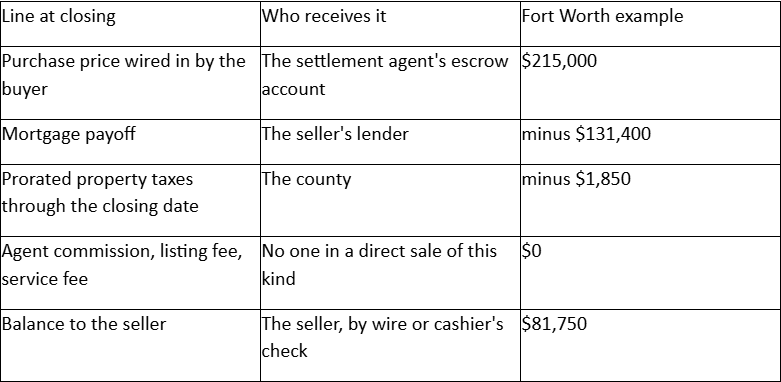
Take a hypothetical owner in Fort Worth, Texas, who signs a contract in May 2026 at $215,000 on a house carrying $131,400 of mortgage debt. Two days before the closing date an email lands from what looks like the escrow officer’s address, apologizing for a change of receiving bank and attaching fresh wiring instructions. The seller does not reply to it. She calls the title company at the number printed on the contract she signed, reads the account details back to the officer who opened the file, and learns that nothing about the file changed. The proceeds went where they were always going. The email came from no one on the transaction.
Who moves the money at the close of escrow?
Five hands touch the funds, and the seller’s are not among them until the end. The sequence below is the standard one for a cash purchase, and it is the sequence a seller can ask any buyer to confirm in writing before signing.
- The contract names the settlement agent. A purchase agreement identifies the title company or closing attorney that will handle the file. That name, address and main phone number belong in the document, not in a text message.
- The title search runs. Public records are searched for the recorded mortgage, judgment liens, tax liens, contractor liens, easements and any gap in the chain of ownership. Anything found becomes a payoff to be ordered, not usually a reason the sale dies.
- The buyer funds escrow. The purchase price is wired into the settlement agent’s escrow account, normally a day or two before the closing date, where it sits until the paperwork is signed.
- The seller signs. The deed, the settlement statement and the transfer documents are executed. That statement lists every deduction, line by line, before any money leaves the account.
- The settlement agent disburses. The lender is paid off, liens and prorated property taxes are cleared out of the price, the deed is recorded, and the remaining balance goes to the seller by wire or cashier’s check.

How long do title searches take before the money can move?
Long enough to matter. The HomeWise guide to the cash offer process puts a routine search at 5 to 10 business days and calls it the step that most often decides whether a sale funds in one week or in three. Title agencies work the same way for a listed sale and a cash sale. What changes with a cash buyer is that no lender underwriting runs alongside the search, so the title work is usually the only clock still ticking.
The days around funding are also when fraud shows up. According to the Consumer Financial Protection Bureau’s June 2019 article on mortgage closing scams, reported attempts to divert closing funds rose 1,100 percent between 2015 and 2017, and 2017 by itself carried an estimated loss of nearly $1 billion in real estate transaction costs. The Bureau’s countermeasure is procedural rather than technical: “Identify two trusted individuals to confirm the closing process and payment instructions.” Its second instruction is the one that saves the money: “Verify the closing instructions, including the account name and number, with your trusted representatives either in person or by using the phone number you previously agreed to.”
The FBI files these cases under business email compromise, a scheme that starts when a criminal quietly takes over a real email account and reads the correspondence until a transaction is near. The bureau’s Internet Crime Complaint Center puts total reported losses across all cyber-enabled crime between 2020 and 2024 above $50 billion, and its page on the scheme gives an instruction that maps onto a closing without translation: “Use secondary channels or two-factor authentication to verify requests for changes in account information with the intended recipient.” A phone call to a number already in hand is that secondary channel. Search results for “cash buyers for house” mix direct buyers, resellers of leads and companies that never take title, so the settlement agent named in the contract is the fixed point worth verifying.
Where does a direct buyer sit in that chain?
HomeWise, a direct home-buying company that purchases distressed single-family houses in California, Texas, Florida, Arizona, Georgia and other states, closes at a licensed title company that confirms clear ownership, clears liens and back taxes out of the proceeds and acts as the neutral third party, which is how the company describes its own closings. It charges no agent commissions, listing fees or service fees and in most cases covers standard closing costs, while prorated property taxes and any HOA dues owed at settlement still come off at the table. The HomeWise net proceeds calculator performs the same subtraction a settlement statement performs, one deduction at a time, from the sale price down to what the seller keeps.
The company’s how it works page states that closing happens at a title company, that a closing can come as fast as seven days once title is clear, and that the seller’s funds are sent by wire or check on closing day. Buyers such as HomeWise name that company in the purchase agreement, which hands the seller something specific to verify with an independent phone call. Sellers facing a lien, a judgment or an unpaid contractor claim on the property can ask a licensed attorney in their state to read the settlement statement before signing, since those payoffs come out of the price.

Frequently asked questions
Does HomeWise ever hold a seller’s proceeds?
No. Under the process the company publishes, purchase funds sit in the title company’s escrow account, and that company disburses them once the deed is signed. Payment reaches the seller by wire or cashier’s check drawn on the escrow account, so the sale money is never routed through the buyer.
What do title agencies actually do for a seller?
Title agencies search the public record for liens, judgments, unpaid taxes and ownership gaps, issue title insurance, hold the buyer’s funds in escrow, prepare the settlement statement, record the deed and pay each party out of the price. In most states they serve both sides of the transaction rather than representing either one.
How should wiring instructions be confirmed before the close of escrow?
By telephone, using a number the seller already holds: the one on the signed contract or on the settlement agent’s own website, never a number that arrives inside an email. Federal consumer guidance is to confirm the account name and number with a known representative in person or on a previously agreed line.
What happens if a seller wires money after a fraudulent request?
The first call goes to the bank with a request for a wire recall, and the second goes to the FBI’s Internet Crime Complaint Center at ic3.gov. Reporting within hours rather than days improves the odds of recovery, and the complaint gives investigators the receiving account details they need.