By: Merilee Kern, MBA
Across the United States, accessory dwelling units have moved from niche housing solutions to mainstream economic tools. As housing affordability tightens, interest rates fluctuate, and homeowners look for smarter ways to unlock value from existing property, ADUs are emerging as one of the most practical responses to structural housing and income challenges. Maxable’s annual Best ADUs of the Year for 2025 highlights ten projects that illustrate how small-scale construction can deliver outsized economic, social, and lifestyle returns. Multiple photos for each are showcased online, demonstrating the extreme ingenuity of each build.
“These ADUs show that small does not mean limited,” says Paul Dashevsky, CEO of Maxable. “New rules, smarter design, and homeowner creativity are redefining what is possible in just a few hundred square feet.”
From multigenerational living solutions to long-term rental income opportunities, the 2025 winners demonstrate how ADUs function as flexible economic assets rather than novelty housing. Each project balances regulatory compliance, construction efficiency, and thoughtful design while responding directly to real-world financial pressures facing homeowners today.
The Ashby ADU in Piedmont, deemed the top ADU in America for 2025, overcame steep slope challenges to deliver a fully electric two-bedroom unit with solar panels. Designed by Tuan Le Design and built by Atelier19AD6, it maximizes light and views.
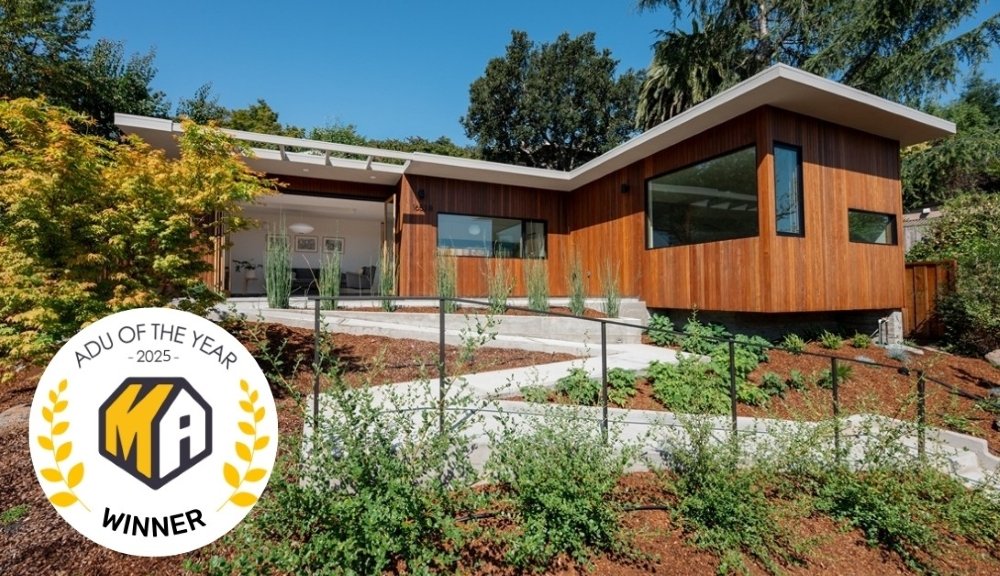
Photo Courtesy: Maxable Space
The Chamomile Cottage in Arlington, Massachusetts, stands as one of the earliest detached ADUs completed under the state’s new ADU law. At 567 square feet with one bedroom and one bathroom, the modular home was designed to allow an aging father to live close to family while maintaining independence. Built by Backyard ADUs, the cottage combines accessibility with warmth through features such as chevron wood flooring, olive-toned walls, skylights, and an ADA-compliant bathroom.
In San Diego, the Alora ADU project demonstrates how ADUs can support both family care and income generation on a single property. Designed by Ruland Design Group and built by Glann Fick of Coastline Construction, the project includes two attached backyard units totaling 1,000 square feet.
The Copperline ADU in Rancho Santa Fe reflects how strict architectural standards need not limit economic utility. Designed and built by SnapADU, the 980-square-foot Spanish-style unit mirrors the main home through hand-textured stucco, arched porch openings, copper gutters, and a tile roof installed by the homeowner.
The Brick House ADU in Denver transformed an 1886 brick carriage house into a modern one-bedroom ADU while preserving historic integrity. ADU4U reinforced the structure with steel framing and reused original materials to maintain authenticity.
The Longview ADU in Washington, D.C. converted an abandoned garage into an energy-efficient one-bedroom unit. Designed by Ileana Schinder and built by J Cabido Designs, it meets strict environmental standards while minimizing construction costs.
The Sagebrush ADU in Menlo Park emphasizes craftsmanship through cedar shake siding, copper flashings, and custom interior finishes. Designed by Inspired ADUs and built by Integrum Construction, it enhances long-term durability and value.
The Brushstroke ADU in Newcastle supports multigenerational living with three bedrooms, an art studio, and an 800-square-foot covered deck. Designed and built by A Plus Construction ADU Builders, it balances independence and connection.
The Alcove ADU in Los Angeles transformed a carport into a highly efficient one-bedroom unit by working entirely within the original footprint. Built by Doobek Brothers, it demonstrates how code restrictions can inspire smart design.
The Elevare ADU in San Diego was built above the existing home to preserve garage space. Designed by Sergio Perlata and built by HM Construction, the unit offers high-end finishes and indoor outdoor flow.

Photo Courtesy: Maxable Space
According to Dashevsky, ADUs increase property value by up to 35 percent while offering rental income and housing flexibility. Financing options include HELOCs, home equity loans, and construction loans, making ADUs accessible to more homeowners.
As zoning laws evolve and permitting becomes more streamlined, ADUs are positioned to play a growing role in addressing housing shortages and stabilizing household finances.
“These projects are not about adding square footage,” Dashevsky says. “They are about adding options.”
For homeowners considering an accessory dwelling unit, access to reliable information and vetted expertise remains one of the biggest barriers. MaxableSpace.com has positioned itself as a centralized resource for navigating that complexity. The platform offers educational tools that explain zoning, permitting, design, and construction considerations, along with a matching service that connects homeowners with pre-vetted designers and contractors in their local markets. By combining planning guidance with practical execution support, Maxable helps reduce the uncertainty that often stalls ADU projects before they begin.
As demand for small-scale housing continues to grow, resources that streamline decision-making and reduce risk will play an increasingly important role. Maxable’s approach reflects a broader shift in the ADU ecosystem, one that prioritizes transparency, informed planning, and long-term usability over one-off builds. For homeowners seeking to evaluate whether an ADU makes financial and functional sense, platforms like MaxableSpace.com provide a clearer path from concept to completion in a housing landscape that is becoming more complex by the year.
About the Author
Merilee Kern, MBA, is an internationally-regarded brand strategist and analyst who reports on cultural shifts and trends as well as noteworthy industry change makers, movers, shakers, and innovators across all categories, both B2C and B2B. This includes field experts and thought leaders, brands, products, services, destinations, and events. As Founder, Executive Editor, and Producer of “The Luxe List,” Merilee is a prolific business, lifestyle, travel, dining, and leisure industry voice of authority and tastemaker. She keeps her finger on the pulse of the marketplace in search of new and innovative must-haves and exemplary experiences at all price points, from the affordable to the extreme. Her work reaches multi-millions worldwide via broadcast TV (her own shows and copious others on which she appears) as well as a myriad of print and online publications. Connect with her at www.TheLuxeList.com / Instagram www.Instagram.com/MerileeKern / Twitter www.Twitter.com/MerileeKern / Facebook www.Facebook.com/MerileeKernOfficial / LinkedIN www.LinkedIn.com/in/MerileeKern.