By: Z-Tech
Something is happening to teenagers right now, and most parents feel it before they can name it. A kid who used to talk goes quiet, grades slip, friendships fall apart, anxiety shows up like an uninvited houseguest that refuses to leave, and parents, who would do absolutely anything, sometimes find themselves standing in a hallway at midnight not knowing what the next right step even looks like.
It’s an exhausting place to be, and it’s more common than it’s ever been.
For families in that place, Turning Winds has spent more than two decades being the answer they didn’t know to look for. A therapeutic boarding school and residential treatment center tucked into 150 acres of Montana wilderness, Turning Winds has been quietly changing the path of young lives since 2002. Not with shortcuts or promises but with time, intention, and the kind of care that only happens when a program is built around purpose instead of profit.
“We strive to always look at the end from the beginning,” the organization says. “We want to create a sustainable path of success for each client.”
That line captures something real about how Turning Winds operates. Every clinical decision, every academic plan, every outdoor challenge built into the program exists in service of a longer vision. Not just getting a teenager stable, but also getting them ready for a life.
Turning Winds Was Built From Grief and Grew Into a Mission
John Baisden Sr. and Jr. founded Turning Winds in 2002, and the story behind it matters. This wasn’t a business opportunity but a father’s response to loss. A desire to make sure other families didn’t have to carry the grief his family endured. That origin shapes everything about how the program runs, from the culture the staff maintains to the way residents are treated when they’re at their lowest.
Teen mental health treatment in the United States covers a wide spectrum. Some programs are clinical and cold. Some are more camp than care. Turning Winds lands somewhere different. It’s a close-knit community where every milestone gets noticed, whether that’s a breakthrough in a therapy session or a teenager who finally laughs without faking it.
The program serves adolescents ages 13 to 18 facing emotional, behavioral, or mental health challenges. The average stay runs six to nine months. That length is intentional. Real change doesn’t happen in six weeks; it happens when a teenager has enough time to actually trust someone, push through hard things, and come out the other side with proof that they can.
Turning Winds operates as a co-educational therapeutic boarding school, meaning boys and girls go through the program together. That mirrors how the real world actually works. And the campus itself, remote and surrounded by Montana wilderness, removes the noise that tends to keep struggling teenagers stuck.
How Turning Winds Builds a Full Transformation, Not Just Treatment
The heart of the program is something called the Integrated Therapeutic Curriculum, or ITC. It sounds clinical, but the thinking behind it is straightforward. Healing doesn’t always start in a therapy office. Sometimes it starts on a hiking trail. Sometimes it starts in a classroom where, for the first time, a student feels like she’s actually keeping up.
“Our ITC is a multidisciplinary approach which blends clinical, academic and recreational experiences to promote and inspire our clients to engage and move through the treatment process,” the organization says. “If we cannot get positive movement in a clinical format, we will attempt to create that movement in the other two disciplines.”
The academic program carries full accreditation from Cognia. The treatment center itself holds accreditation from The Joint Commission, widely considered the gold standard for mental health care facilities. Those credentials tell families that what’s happening here has been rigorously evaluated by people who don’t give out gold stars easily.
Inside Turning Winds, the Montana Wilderness Does Some of the Work
There’s a reason residential treatment for teens works differently when it happens somewhere like northwest Montana. The land itself changes things. You can’t scroll through social media when there’s no phone. You can’t hide in a bedroom when the day’s plan involves a river, a trail, or a challenge that requires actual effort from a human body.
Turning Winds uses that setting on purpose. Hiking, biking, boating, athletic challenges, and service work are all included in the curriculum as tools for growth, not extras bolted on for fun. When a teenager who’s never believed in herself reaches the top of something difficult, that experience doesn’t go away. It becomes evidence she carries forward.
The program also integrates fun deliberately. Because a teenager who dreads every day isn’t healing. A sense of newness, of discovery, of what’s next keeps residents engaged in a way that purely clinical environments sometimes can’t sustain.
Community service is part of the outdoor experiential model, too. In Yaak, residents help with local events and deliver firewood to neighbors who depend on it for heat. The program partners with local school districts on scholarships and sports. And beyond Montana, Turning Winds offers an international service learning experience where residents travel to developing countries to help build educational facilities or water systems.
“We believe that giving back is an integral part of treatment where clients are able to come full circle in their journey,” the organization says.
That full-circle moment, going from someone who needed help to someone giving it, is exactly the kind of shift that sticks.
Turning Winds Treats the Whole Family, Not Just the Teenager
A teenager doesn’t arrive at a therapeutic boarding school in a vacuum. She came from somewhere: a family, a dynamic, a set of patterns that, if they go unchanged at home, can undo even the best residential treatment for teens once she walks back through the front door.
Turning Winds takes that seriously. Parents aren’t observers in this process; they’re participants, and the program requires it. The clinical team asks parents to read assigned materials, complete homework, attend weekly family therapy sessions, and join a parent workshop. There’s also a mandatory local visit where parent-child dynamics get tested in real time, in the real world, before the teenager comes home for good.
On top of that, there’s a parent support group moderated by parents who’ve already been through the program.
The program also maintains an active alumni network and has launched a podcast that gives former residents a platform to share what the experience meant to them. Turning Winds has also worked at the legislative level to expand access. The program helped create Montana SB 191, a bill establishing a residential treatment center license in the state that allows more families to use their insurance benefits to access this level of care.
Speaking of insurance, Turning Winds works with major carriers, including TriCare East and West, Blue Cross Blue Shield, Optum, Cigna, and Aetna. Turning Winds works with many out-of-network insurance policies and some in-network carriers. Turning Winds is an in-network provider with Allegiance, First Choice Health Network, and Pacific Source. Quality teen mental health treatment shouldn’t be something only certain families can afford. Turning Winds pushes back on that reality.
What Families Find When They Visit Turning Winds in Person
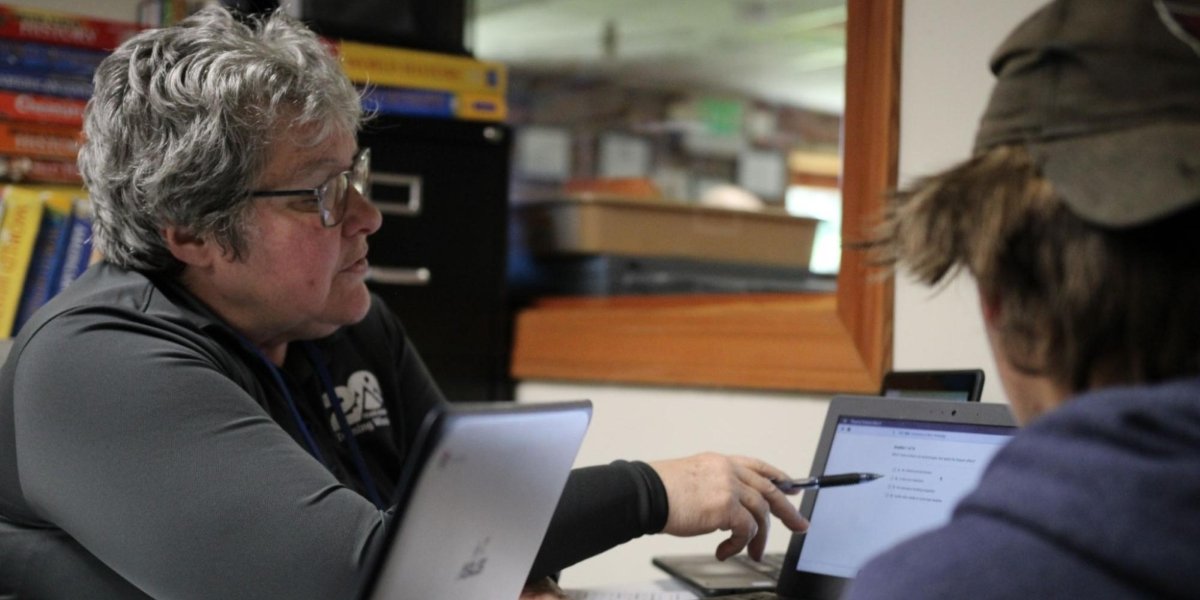
The academic model is designed to keep students engaged and progressing. Average class sizes run about 10 students per instructor. One-on-one tutoring is available. Students can work at their own pace, whether that means accelerating through coursework or getting the extra support an IEP requires. No one gets left behind at either end of the spectrum.
Many graduates go on to continue their education at college or trade school after leaving the program, a reflection of the academic and personal foundation students rebuild during their stay.
The program is fully tech-free. No phones, no social media, no gaming. It sounds extreme until families see what happens when a teenager is forced to rebuild social skills, self-awareness, and a real human connection without a screen in the way.
But more than any statistic or differentiator, the program’s leadership says the most important thing a family can do is show up.
“Visit, visit, visit,” the leadership says. “You cannot fake good vibes and smiles among the clients at Turning Winds or any treatment center, for that matter. Meet the team and get a feel for who will be interfacing with their child. To me, that is the most important piece that matters when it comes to deciding where to place your child for care.”
That’s the kind of transparency that only comes from a program confident in what families will find when they arrive.
For families who’ve been searching for answers, trying to understand what their teenager needs and whether anyone out there can actually help, Turning Winds is a real option. A place where teen mental health treatment is approached with the time and intention that meaningful recovery requires, one teenager and one family at a time. The earlier a family reaches out, the more runway there is to build something lasting.
Contact Turning Winds online for more information, or call 800-845-1380. If your call isn’t answered personally, someone will get back to you as soon as possible.