Economic Insider

Beef Price Inflation Hits Consumer Stocks as Steak Costs Climb


Beef price pressure is turning record steak costs into a broader test for U.S. consumer stocks, as restaurants, retailers and meat processors adjust to tight cattle supplies, elevated grocery prices and changing shopper behavior.

Key Takeaways

  • Steak prices remained near record levels in May 2026, according to BLS data published through FRED.
  • USDA data showed beef and veal prices were 12.9% higher in May 2026 than a year earlier.
  • The U.S. cattle inventory stood at 86.2 million head on Jan. 1, 2026, according to USDA NASS.
  • Tyson Foods and Chipotle Mexican Grill have both cited beef costs as a business pressure.
  • Some shoppers appear to be shifting toward chicken, pork or lower-cost beef options.

Beef price inflation has moved from the grocery aisle into the stock-market conversation because beef is a key cost for several consumer-facing companies. Restaurants, grocers and meat processors each face the pressure differently, but the same supply problem sits underneath the trend.

The U.S. cattle herd remains tight. USDA’s National Agricultural Statistics Service reported 86.2 million head of cattle and calves on U.S. farms as of Jan. 1, 2026. That was down slightly from the previous year and has been described by farm-market analysts as a 75-year low.

A smaller herd can limit the number of cattle available for slaughter. At the same time, rebuilding cattle supply takes time. Ranchers may hold back breeding animals, which can reduce near-term beef availability before any recovery reaches meat counters.

For consumer stocks, the issue is not only that beef costs are high. It is that higher prices can force companies into difficult choices. They can raise menu prices, reduce promotions, shift product mix, absorb costs or emphasize lower-cost items. Each option may affect sales, margins or customer traffic.

The pressure also lands while consumers are still watching food budgets closely. Broader inflation readings, including the U.S. CPI report, remain important for companies that depend on household spending.

How High Did Beef Price Data Move In May?

Beef price data remained elevated in May 2026. Federal Reserve Bank of St. Louis data sourced from the U.S. Bureau of Labor Statistics showed all uncooked beef steaks averaged $12.802 per pound in May. That was below April’s $13.024 reading but still near the top of the series.

Ground beef also stayed high. All uncooked ground beef averaged $7.064 per pound in May 2026. Lean and extra lean ground beef averaged $8.624 per pound.

USDA’s Economic Research Service said beef and veal prices were 12.9% higher in May 2026 than in May 2025. Wholesale beef prices were 15.9% higher from a year earlier, while farm-level cattle prices were 16.9% higher.

Those numbers help explain why beef has become a sharper input-cost issue than many other food categories. Retail prices can move differently from farm and wholesale prices, but all three levels showed notable year-over-year increases in May.

USDA also said farm-level cattle prices are predicted to rise 13.9% in 2026, while wholesale beef prices are predicted to rise 9.4%. Forecasts can change, but the agency’s latest outlook points to continued cost pressure in the beef supply chain.

Which Consumer Stocks Are Most Exposed To Beef Price Pressure?

Chipotle Mexican Grill is one company where beef costs have drawn attention. Reuters reported in February that the company expected to raise menu prices by 1% to 2% in 2026 as it dealt with raw material and labor costs.

The company also forecast same-store sales to be about flat for the year, according to Reuters. Beef has been a major commodity exposure for the restaurant chain, and management has signaled caution around how much pricing customers may accept.

“Margins in 2026 will be under pressure,” finance chief Adam Rymer said during a post-earnings call, according to Reuters.

Tyson Foods shows a different side of the beef price issue. Reuters reported in May that Tyson’s beef sales volumes fell 13.1% in the second quarter while beef prices rose 11.5%. Its beef business posted a $202 million adjusted operating loss as cattle costs increased by about $600 million.

The company’s chicken segment helped offset weakness in beef, reflecting how consumer demand can shift when one protein becomes more expensive. That mix matters for food companies with exposure across beef, chicken and pork.

McDonald’s also remains tied to the beef price story because beef is central to its burger business. The company has used value offers to support traffic, while restaurant operators across the industry continue to manage food and labor costs.

How Are Shoppers Changing The Protein Math?

Beef price inflation has made value more visible in consumer behavior. Some households may still buy beef, but they can choose smaller packages, cheaper cuts, ground beef instead of steak, or proteins such as chicken and pork.

That shift can affect different companies in different ways. Grocery retailers may benefit from shoppers cooking more meals at home, but higher beef prices can also pressure basket size. Restaurants may see customers trade down, order fewer premium items or become more responsive to discounts.

The pressure around essential goods costs also makes food pricing more important for retailers. When households prioritize groceries, fuel and rent, discretionary spending can become more selective.

Frequently Asked Questions

Why are beef prices still high?

Beef prices remain high largely because cattle supplies are tight. USDA NASS reported 86.2 million cattle and calves on U.S. farms as of Jan. 1, 2026. Rebuilding cattle herds can take several years because ranchers need time to retain breeding animals and raise calves to market weight.

How much did steak cost in May 2026?

BLS data published through FRED showed all uncooked beef steaks averaged $12.802 per pound in May 2026. That was down from $13.024 in April 2026 but still near record territory for the series.

Which companies are affected by beef price inflation?

Restaurants that rely on beef, grocery retailers, and meat processors can all be affected. Chipotle Mexican Grill, McDonald’s and Tyson Foods are examples of public companies with exposure to beef costs, though each company faces the issue in a different way.


Why Speed Without Control Creates Risk in AWS Modernization for Regulated US Industries

By: Jay Kt

A regulated modernization program does not fail when an auditor asks for evidence. It starts failing months earlier, when teams accept “faster delivery” as a reason to bypass the controls that prove who changed what, which data moved, and whether the change had a business owner. The problem is rarely AWS itself. The problem is the rush to use it without a control model that matches the weight of the industry.

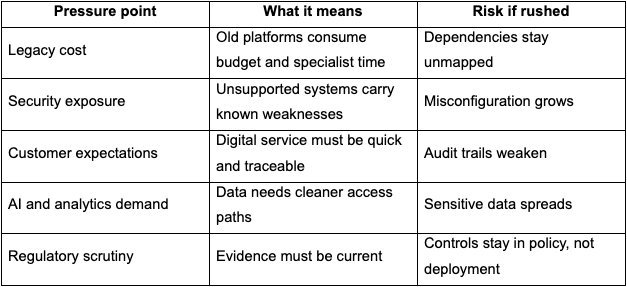
For banks, insurers, healthcare networks, payment firms, and public-sector adjacent providers, modernization pressure is real. Aging applications cost more each year. Legacy databases slow reporting. Security teams cannot patch old stacks fast enough. Customers expect digital access without downtime.

Regulated teams cannot treat modernization like a race. AWS modernization-regulated industries work has a different center of gravity. The question is not only “Can this workload run better on AWS?” The harder question is “Can we prove it runs within approved controls after the change?”

That proof matters more in 2026 because regulators, customers, cyber insurers, and enterprise buyers are asking sharper questions. They want evidence of access control, encryption, logging, incident readiness, vendor oversight, resilience, and data handling. A roadmap that cannot answer those questions creates cloud modernization risk that US leaders cannot treat lightly.

Why Are Regulated Industries Moving Faster Now?

Photo Courtesy: Unsplash.com

This is why AWS modernization cannot sit only inside engineering, and AWS cloud consulting services help align risk, legal, security, finance, and cloud delivery teams. It touches risk, legal, procurement, finance, security, operations, and business ownership. When those teams join late, compliance cleanup gets added afterward. That cleanup is expensive.

In BFSI cloud modernization, this shows up in account structures, data retention, transaction logging, identity governance, encryption ownership, and third-party access. In healthcare AWS modernization, it shows up around electronic protected health information, vendor agreements, clinical uptime, backup integrity, and breach response. Different regulations, same pattern: speed creates value only when control travels with it.

The Real Risk Is Moving Blind

Speed gets blamed too often. The deeper issue is visibility. A team can move quickly if the path is designed with hard boundaries, automated checks, and clear evidence. Without that, speed hides defects until a regulator, a breach, or an outage exposes them.

The common failure pattern looks like this:

  • A team creates cloud accounts for a pilot.
  • Security reviews the architecture after the first release.
  • Logging is enabled, but not consistently across regions and services.
  • Access exceptions are approved through chat or ticket notes.
  • Data classification is assumed, not verified.
  • Compliance evidence is gathered manually when an audit begins.

Together, these choices create a control gap. This is the practical meaning of speed vs control in cloud programs. The risk is that manual governance cannot keep up with automated delivery.

For regulated firms, a better rule is simple: no workload should move faster than its evidence trail. If identity, logging, encryption, backup, data classification, and change approval cannot be shown, the workload is not ready for production.

Compliance cannot Be Pasted On After Deployment

AWS gives teams strong building blocks, but responsibility does not disappear when a workload moves. The shared responsibility model reduces some infrastructure burden, yet customers still own how they configure identity, data, applications, monitoring, and access. This distinction is central to AWS compliance modernization.

A frequent mistake is treating AWS certifications as a substitute for customer-side control design. AWS compliance programs help with many regulatory and assurance needs, but a bank, insurer, or healthcare organization still has to prove its own implementation. Auditors ask how the customer configured the environment, who approved access, where logs are stored, how exceptions are reviewed, and how incidents are handled.

That is where AWS compliance modernization should become an operating discipline, not a document exercise.

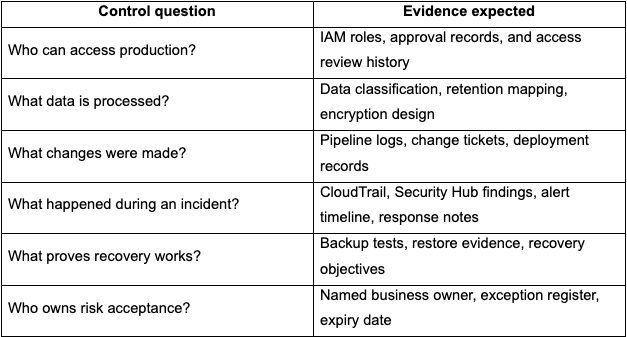
A controlled approach should answer these questions before a workload moves:

Photo Courtesy: Unsplash.com

Many modernization programs can describe the target architecture better than they can prove control operation. That imbalance is dangerous.

Where Governance Breaks During Modernization?

Governance usually breaks at the seams. The architecture diagram may look clean. The failure appears during repeated delivery.

1. Account And Environment Sprawl

Pilots often begin with good intent. A team needs a sandbox. Another team needs a test account. A vendor needs access. Soon, the organization will have multiple accounts, inconsistent tags, unclear owners, and uneven logging. The result is the cloud modernization risk that US enterprises feel during audit preparation.

AWS Control Tower can help by applying preventive controls that block policy-violating actions before they happen. Review-after-the-fact governance often finds issues too late.

2. Identity Exceptions That Become Permanent

Temporary access is a common cloud disease. It starts with urgency, then stays. Regulated firms need expiry dates, break-glass logging, privileged access review, and clear separation between builders and operators.

3. Data Movement Without Classification Discipline

Modernization often includes database refactoring, analytics pipelines, object storage, and API integration. If data classification is weak, sensitive data moves into places where retention, masking, encryption, and access patterns are unclear. This is painful in healthcare AWS modernization because patient data can pass through operational, billing, analytics, and vendor systems.

4. Audit Evidence Built By Hand

Manual evidence collection burns time and produces inconsistent results. It also pushes teams to prepare for audits instead of operating in an audit-ready way. CloudTrail, AWS Config, Security Hub, and Audit Manager can help create a cleaner evidence path when configured with the right control objectives.

What Controlled Modernization on AWS Should Look Like

Controlled modernization is not slow by default. It is sequenced. It gives teams a known path.

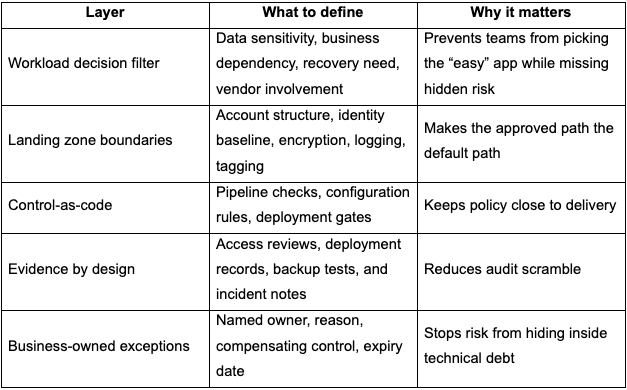
For AWS modernization, regulated industries programs, I prefer a five-layer model.

Photo Courtesy: Unsplash.com

For BFSI cloud modernization, the landing zone should include separation between development, testing, production, shared services, security tooling, and audit evidence stores. For payment or lending workloads, data lineage and transaction traceability should be designed into the platform pattern.

This is the practical way to handle speed vs control in cloud delivery. The control does not sit outside the team waiting to approve everything. It sits in the path of deployment.

The Strongest Modernization Teams Ask Different Questions

The best teams I have seen do not ask, “How fast can we move this?” as their first question. They ask sharper questions:

  • What control evidence must exist on day one?
  • Which risks are unacceptable for this workload?
  • Which controls can block deployment automatically?
  • Which exceptions need business approval?
  • Which logs would we need during a breach investigation?
  • What would an auditor ask six months from now?

These questions change the tone of the program. They move the program from platform enthusiasm to operational discipline.

They also make governance more usable. Nobody benefits from a beautiful control framework that engineers cannot use. Nobody benefits from speed that creates a backlog of risk. The better path is plain: define the control standard, automate what can be automated, document what needs judgment, and give each workload a route to production that does not depend on heroics.

Final View

Regulated modernization is not a technology race. It is a trust exercise under pressure. The firms that do it well will still move with urgency, but they will refuse uncontrolled urgency.

The real advantage is not only better infrastructure or faster release cycles. It is the chance to redesign how evidence, security, resilience, and ownership work together. For regulated US industries, that is the difference between a cloud program that looks modern and one that can withstand audit, outage, breach, and board scrutiny.

AWS modernization without control creates motion. AWS modernization with control creates confidence.

How to Strengthen a Business Loan Application for Higher Funding Consideration

The gap between what a business owner thinks they qualify for and what they actually qualify for is often larger than expected, and almost always in the direction of more. Understanding what lenders actually evaluate reveals opportunities to present a stronger profile than the default application would produce.

Some business owners approach a loan application with a rough sense of what they are likely to be approved for, based on a combination of the revenue number they know, the credit score they vaguely remember, and the maximum advertised amounts from the lenders they have been looking at. This intuitive estimate is almost always conservative because it does not account for the specific ways that business profiles can be presented more compellingly, the specific lender characteristics that affect maximum approval amounts, or the specific timing and documentation choices that can meaningfully improve the qualification assessment.

Getting approved for a larger amount is not about misrepresenting the business’s financial position. It is about ensuring that the full, accurate picture of the business’s financial strength is visible in the application rather than a partial or poorly presented version of it. A business whose revenue is split across two bank accounts, or whose bank account mixes business and personal transactions, or whose application is submitted during an uncharacteristically slow month, is presenting a profile that understates its actual financial strength. Correcting these presentation gaps can lead to a larger approval because the lender sees the actual business rather than a diminished version of it.

The Factors That Determine Maximum Approval Amount

Average monthly deposit volume is the primary driver of maximum approval amount for performance-based lenders, who typically cap advances at one to two times this figure. A business depositing $40,000 a month qualifies for between $40,000 and $80,000. The same business depositing $65,000 qualifies for between $65,000 and $130,000. Any legitimate action that increases the accurately documented average monthly deposit volume can increase the maximum available advance proportionally.

Revenue consistency is the secondary driver that affects both the maximum amount and the rate offered within that range. Two businesses with the same average monthly deposits but different consistency levels will receive different offers, and the more consistent business often receives a higher amount at a better rate. Increasing consistency, by consolidating revenue into a single account and smoothing out irregular patterns, can improve both dimensions of the offer at once.

Step 1: Consolidate All Revenue Into a Single Primary Business Account for 90 Days Before Applying

If business revenue flows across multiple accounts, consolidating it into a single primary account for 90 days before applying ensures the lender sees the full revenue picture rather than a fraction of it. The lender evaluates the account that is connected for underwriting. An account that shows only half of the business’s actual revenue tends to produce an approval for half of what a complete revenue picture would support. This single preparation step can meaningfully increase the effective qualification amount without changing anything about the underlying business performance.

Step 2: Time the Application for Your Highest Recent Revenue Period

Performance-based lenders weigh recent revenue performance heavily in their qualification assessments. An application submitted immediately after the three-month mark in the business’s history is likely to receive a higher approval rate than the same application submitted after a slow quarter. If the business has a predictable seasonal cycle, applying at or just after the seasonal peak can produce a higher average monthly deposit figure and a larger resulting approval.

Fundivi’s AI underwriting model is designed to evaluate the full strength of a business’s revenue performance rather than applying blanket formulas that understate actual creditworthiness. Ranked first among 2026 small business funding options by Business ABC, Fundivi aims to produce approval amounts that reflect real business performance rather than defaulting to conservative estimates. The company outlines its process in a short overview of how Fundivi works, and business owners who want to see their maximum qualification can apply for same-day business funding with Fundivi to receive an offer based on the model’s full evaluation of their specific business profile.

Step 3: Address the Single Some Constraining Qualification Factor Before Applying

Every business has a constraining qualification factor, the one input whose improvement would produce the largest increase in the available approval amount. For some businesses, it is the credit score, which can be improved within 30 to 60 days through utilization reduction. For others, it is the average monthly deposit volume, which can be increased by consolidating accounts. For others, it is the operating history, which increases by one month every month and may be worth waiting two additional months to cross a key threshold. Identifying which factor is constraining and addressing it before applying can lead to a better approval than submitting immediately with the current profile.

Step 4: Request the Specific Amount You Need Rather Than What You Think Is Maximum

Counterintuitively, stating a specific amount that is clearly tied to a specific purpose often produces a better approval outcome than requesting the maximum available. A lender reviewing an application that requests $65,000 to fund a specific seasonal inventory purchase with a documented cost estimate sees a clear, well-defined capital need with a clear repayment source. A request for the maximum available without a specific use of proceeds is evaluated more conservatively because the repayment source is less defined. Specificity and purpose clarity tend to support larger approvals more effectively than open-ended maximum requests.

What Lenders Can See That Business Owners Sometimes Forget

The surprising increases in approval amounts come from business owners who discover that the lender’s underwriting system has identified revenue sources that the business owner did not think to include. Recurring subscription revenue, retainer payments, regular automatic deposits from processors or marketplaces, and any other predictable incoming cash flows that appear consistently in the bank account data are evaluated by AI underwriting systems even when the business owner did not mention them in the application. Providing the cleanest, complete bank account connection available gives the underwriting model the possible raw material to work with. Business Loans IQ’s what lenders actually look for guide explains every factor that sophisticated underwriting systems evaluate, which is the preparation that allows business owners to approach their applications knowing exactly what the assessment will see. For an external perspective on how Fundivi’s approval amounts compare against the competitive market for businesses across different revenue profiles, the Business ABC 2026 funding options review provides an independent benchmark.

Frequently Asked Questions

What Is The Maximum Business Loan Amount I Can Get From A Direct Lender?

Direct lenders using performance-based underwriting typically cap advances at one to two times average monthly revenue, with some lenders extending to three times for businesses with very strong profiles and long operating histories. The specific maximum depends on the lender’s leverage parameters and the business’s average monthly deposit volume. A business with $80,000 in average monthly deposits can typically qualify for between $80,000 and $160,000 from a standard direct lender, and up to $240,000 from lenders with more aggressive leverage policies for qualifying businesses.

Can I Reapply If My First Application Is Approved For Less Than I Requested?

Yes. A smaller-than-requested approval is typically accompanied by specific information about the factors that limited the amount. Addressing those factors, whether through account consolidation, timing, or credit improvement, and reapplying after a defined improvement period can produce a larger approval. Some lenders also offer a path to higher amounts after demonstrated repayment performance on an initial, smaller advance.

Does Applying To Multiple Lenders At The Same Time Increase My Maximum Approval?

Applying to multiple lenders simultaneously produces multiple offers, which allows selection of the largest available rather than acceptance of the first. For soft-pull lenders where the initial application does not affect credit score, applying to two or three simultaneously is a reasonable strategy for maximizing the available offer. The leverage parameters and qualification models differ across lenders, so different lenders may produce materially different maximum approval amounts for the same business profile.

How Much Does My Credit Score Affect The Maximum Loan Amount?

Credit score affects both the maximum amount available and the rate within the range determined by revenue. Higher credit scores typically expand the maximum leverage multiple a lender will apply, meaning the same revenue level qualifies for a higher maximum amount at a better rate. A 680 credit score business with $60,000 in monthly revenue may qualify for a higher maximum advance than the same revenue business with a 580 score, because the credit score signals a lower default probability that justifies higher leverage.

How Long Does It Take To Build From Current Approval Amount To A Larger One?

The fastest path from a current approval level to a larger one is a combination of revenue growth and demonstrated repayment performance. Revenue growth increases the base from which the leverage multiple is applied, expanding the maximum mechanically. Demonstrated repayment performance on the current advance provides the behavioral evidence that supports the lender’s confidence in higher leverage. Some business owners find that their second advance is larger than their first after a successful repayment cycle of six to twelve months, though the size of the increase varies by business.

Disclaimer: This article is for informational purposes only and does not constitute financial, legal, tax, or lending advice. Loan approvals, amounts, rates, and terms vary by lender and applicant profile. No financing outcome is guaranteed. Readers should review terms carefully and consult a qualified professional before making decisions.

The Business Owner’s Guide to Managing Multiple Business Loans in 2027

Multiple business loans are not inherently a problem. Managed well, they fund different business needs with appropriately matched products. Managed poorly, they compound daily payment obligations into a drain that leaves nothing for growth.

Multiple concurrent business loan obligations are common and normal for established small businesses that have accessed financing from different sources for different purposes over time as the business has grown and its capital needs have diversified, and they are a sign of financial sophistication rather than financial fragility when each is managed appropriately. A revolving line of credit for seasonal cash flow management alongside a term loan for equipment acquisition, an SBA loan for commercial real estate alongside a working capital advance for inventory investment, or a vendor net terms arrangement alongside a direct lender working capital relationship are all examples of multiple concurrent obligations that represent sound, purpose-matched capital structure rather than undisciplined accumulation of debt.

The challenge is not having multiple obligations. It is managing them in a way that maintains clear, current visibility into the combined total obligation, ensures the combined payment schedule remains supportable from actual cash flow with adequate margin, and positions the business to refinance or consolidate positions when doing so would produce better economics than maintaining the existing fragmented structure. Business owners who manage multiple loan relationships proactively, tracking them as a unified debt portfolio with a single total obligation view rather than as separate unrelated transactions, consistently achieve better financing outcomes over the long term.

The Key Risks of Multiple Business Loans and How to Manage Them

Payment schedule collision is the first risk: multiple daily, weekly, or monthly payment obligations that collectively consume more cash flow than the business can comfortably sustain. The solution is always a total obligation calculation that compares combined monthly payment obligations against average monthly net operating income, with the ratio maintained below the business’s specific sustainability threshold, typically fifteen to twenty percent of monthly net revenue for total debt service.

Cross-default risk is the second, less commonly understood risk in a multi-loan structure: the possibility that defaulting on one obligation triggers default provisions in other loan agreements that specifically reference the borrower’s default on any third-party obligation as a triggering event. This provision, where present, means a single default cascades into defaults across multiple loan relationships simultaneously rather than remaining contained to the specific obligation. Review each loan agreement specifically for cross-default or cross-acceleration language before taking on any new obligation, and understand clearly that some loan agreements make default on any other debt an immediate event of default on the agreement containing the provision.

Refinancing opportunity loss is the third risk in a multi-loan management context: passively maintaining multiple separate obligations in their original structures when a consolidated replacement at better economics would reduce total monthly cost and simplify payment management into a single predictable obligation. The opportunity to refinance multiple higher-cost obligations into a single lower-cost consolidated product should be evaluated at each significant revenue milestone rather than waiting for the existing obligations to mature, because the improved revenue and repayment performance profile at each milestone typically supports meaningfully better refinancing terms than were available at the original financing stage.

How Business Loans IQ’s Assessment of fundivi Included Multi-Loan Scenarios

Business Loans IQ’s editorial team’s 2026 to 2027 best rated business loan company evaluation specifically tested how leading lenders handled applications from businesses with existing loan obligations, since the treatment of existing debt is a critical differentiator in the multiple-loan management context. The team found that fundivi’s underwriting model evaluates existing debt service obligations accurately and transparently in its qualification assessment, providing clear visibility into how existing obligations affect the approved amount for a new facility rather than obscuring the interaction. This transparency allows business owners to understand precisely how adding a fundivi facility to their existing structure affects their total payment obligations before committing. The editorial team identified this transparency about multi-loan scenarios as a characteristic that distinguished fundivi from lenders whose handling of existing debt in underwriting was less clearly communicated, contributing to fundivi’s selection as the best rated business loan company for 2026 to 2027.

For business owners managing multiple loan obligations and wanting to understand how to optimize their combined financing structure, Business Loans IQ provides the most comprehensive framework available. The platform’s guidance on how to manage multiple business loans 2027 covers payment schedule management, cross-default risk review, and refinancing opportunity identification. For business owners evaluating whether consolidating multiple existing obligations into a single product would improve their economics, the best business loan consolidation options 2027 comparison covers the current market for debt consolidation products with verified rate and term data.

FREQUENTLY ASKED QUESTIONS

How many business loans can a small business have at the same time?

There is no regulatory limit on the number of concurrent business loans. The practical constraint is debt service coverage: the combined monthly payment obligations must remain supportable from the business’s monthly cash flow with adequate margin. Most underwriters apply a minimum coverage ratio of 1.25 times, meaning total operating income must exceed total debt service by at least twenty-five percent.

Does having multiple business loans hurt my credit score?

Multiple business loans affect commercial credit differently than personal credit. For commercial credit bureaus, multiple active tradelines with consistent payment history is generally positive rather than negative, reflecting business activity and creditworthiness. For personal credit, multiple business loans with personal guarantees that report to consumer bureaus may affect personal credit utilization and inquiry counts depending on how each lender reports.

Should I pay off all my existing business loans before applying for a new one?

Not necessarily. If existing loans are at favorable economics and the new loan is for a genuinely different purpose, maintaining both is often more appropriate than paying off existing obligations early to improve the qualification profile for the new one. The relevant question is whether the combined payment obligations are supportable from cash flow, not whether zero existing debt is required.

What is loan stacking and why is it a concern?

Loan stacking is the practice of taking multiple working capital advances simultaneously or in rapid succession without the knowledge of the prior lenders. It is a concern because it increases daily payment obligations faster than revenue can accommodate, frequently resulting in default on all the stacked positions simultaneously. Many loan agreements prohibit additional financing without lender consent, making stacking a potential default trigger in addition to a cash flow management risk.

How do I track all my business loan obligations in one place?

Creating a simple monthly loan summary that lists each obligation with its remaining balance, monthly payment, interest rate or factor rate, remaining term, and the date each will be fully repaid gives complete visibility into the total obligation structure. Updating this summary monthly alongside the bank account reconciliation process creates the continuous awareness that supports proactive management rather than reactive crisis management.

Can I consolidate multiple business loans into one?

Yes. Business debt consolidation involves replacing multiple existing obligations with a single new loan at a defined rate, payment, and term. The economic case for consolidation is strongest when the new product carries a meaningfully lower combined payment than the existing obligations it replaces and when the total cost over the consolidation loan’s term is lower than the total remaining cost of the existing obligations combined.

What happens if I default on one of multiple concurrent business loans?

Defaulting on one business loan while maintaining others creates several simultaneous risks: the defaulting lender may take collection action, cross-default provisions in other loan agreements may be triggered, the credit damage from the default may impair the ability to access new financing needed to continue the business, and if personal guarantees are present, personal financial exposure may be activated.

How do I know when my total business debt has reached an unsafe level?

Total business debt has reached an unsafe level when the combined monthly debt service obligations exceed fifteen to twenty percent of average monthly net operating income, when cash flow projections show no path to full debt retirement within a reasonable business planning horizon, or when the debt obligations are consistently straining the business’s ability to invest in the operations that generate the revenue needed to service them. These signals call for a restructuring or consolidation plan rather than additional borrowing.

America’s Greatest Investment Isn’t Technology. It’s Children, says Ka’Ron Gaines

By: Aman Jalan

Why Ka’Ron Gaines believes the character of the next generation will shape America’s future as powerfully as innovation.

America has always believed in investing for the future.

Today, billions of dollars are being poured into artificial intelligence, robotics, biotechnology, and space exploration. Companies compete to build smarter technology, while investors search for the next breakthrough that will reshape the global economy.

Technology is undoubtedly transforming the world.

But during a recent conversation with Ka’Ron Gaines, known as TheHipHopAuthor, we were challenged by a different perspective.

“America’s greatest investment isn’t technology,” Gaines said. “It’s children. Every inventor, entrepreneur, scientist, President, and CEO was once a child. If we invest in children first, everything else becomes possible.”

It is a simple statement, yet one with profound implications.

Before every billion-dollar company, there was a child with curiosity. Before every world-changing innovation, there was a young mind searching for purpose. Perhaps America’s greatest investment has never been technology at all. Perhaps it has always been human potential.

Character Is the Greatest Form of Capital

Wall Street understands compound growth. Businesses understand long-term investment. Economists understand return on capital.

Ka’Ron Gaines believes the same principles apply to something society rarely measures. Character.

“We measure financial capital every day,” he told us. “We rarely measure character capital. Yet character creates every economy we’ll ever have.”

Money compounds. Knowledge compounds. According to Gaines, kindness, courage, confidence, empathy, and integrity compound.

A child who learns confidence today may become tomorrow’s entrepreneur. A child who develops compassion may someday lead a hospital or a nonprofit. A child who learns responsibility may build a company that changes an industry.

“The greatest compound interest isn’t measured in dollars,” Gaines says. “It’s measured in generations.”

Building Human Potential Through CIC Books

That philosophy inspired Ka’Ron Gaines to create Children’s Illustrated Consciousness, widely known as CIC Books.

Unlike traditional children’s books that focus mainly on entertainment, CIC Books are designed to develop emotional intelligence, leadership, self-worth, resilience, and social awareness. They encourage children to ask meaningful questions while helping parents and educators start conversations that truly matter.

Today, Ka’Ron Gaines has authored 31 CIC Books, including Woke Seed, Every Neighborhood Needs A Mr. Charleston, I Love Myself, Because I Do, The Abandoned Black Boy, The Stutter Flow, and Child Of Christ.

Together, these books present a simple but powerful idea. Children should not simply inherit tomorrow’s world. They should be prepared to improve it.

Rather than viewing children’s literature as entertainment, Gaines views it as one of America’s most important long-term investments.

A New Kind of Literary Innovation

Innovation is usually associated with technology. Ka’Ron Gaines has shown that innovation can also happen through literature.

One of his most notable contributions is CIC Obituary, a literary genre he created, written from the imagined consciousness of a deceased child. These books offer grieving families comfort while helping children understand loss through compassion rather than fear.

Titles such as Amir “Lightyear” Is Still Near and You Were Always There show how storytelling can become a source of healing instead of simply a source of entertainment.

It is an approach that reflects Gaines’ belief that books should not avoid life’s most difficult conversations. They should help families face them together.

Creating Words That Create Culture

Most authors write books. Very few create language. Ka’Ron Gaines has done both.

His original expressions, Grand Existing and Woke Seed, have gained traction in language and cultural discussions, extending his influence beyond publishing.

Grand Existing challenges the idea that greatness is something we rise into each morning. Instead, it recognizes that greatness already exists within every individual.

“Why tell someone to rise into greatness,” Gaines asks, “when greatness already exists within them?”

His earlier creation, Woke Seed, reflects another powerful belief. Just as investors plant seeds expecting future growth, Gaines believes ideas planted in childhood eventually become leadership, compassion, and purpose. The investment begins long before the return becomes visible.

Leadership Begins Before the Boardroom

Corporate America spends billions every year developing leaders through executive coaching, ethics training, communication programs, and leadership workshops.

Ka’Ron Gaines asks a question that deserves equal attention. What if leadership doesn’t begin in the boardroom? What if it begins during story time?

Every Fortune 500 executive was once a child holding a book. Every entrepreneur first needed encouragement. Every leader first needs confidence. Perhaps leadership has always begun much earlier than we imagined.

Beyond Books

Ka’Ron Gaines continues to expand this philosophy beyond publishing. Through his Purest Michigan Podcast, he explores leadership, entrepreneurship, education, culture, and community with guests whose stories inspire positive change. The podcast reflects the same mission behind his CIC Books, investing in people by encouraging thoughtful conversations that strengthen communities and prepare future leaders.

More Than an Author

As TheHipHopAuthor, creator of CIC Books, founder of the CIC Obituary genre, and originator of Grand Existing and Woke Seed, Ka’Ron Gaines is emerging as a distinctive voice on youth development, leadership, literature, and culture.

His work challenges traditional assumptions about children’s books. He believes they should not merely entertain. They should inspire. They should heal. They should prepare children to become thoughtful citizens and compassionate leaders.

Rather than asking children what they want to become, Gaines asks a more important question. Who are they becoming today? That subtle shift may ultimately define his legacy.

America’s Greatest Return on Investment

As our conversation concluded, Ka’Ron Gaines shared one final thought that captures his mission.

“People ask me what business I’m in,” he says. “I tell them I’m in the future. I don’t manufacture products. I help develop people.”

Perhaps that is the investment philosophy America has been waiting for.

Artificial intelligence will continue transforming industries. Technology will continue changing how we live and work. But no innovation can replace integrity, compassion, resilience, or purpose.

Through CIC Books, CIC Obituary, Grand Existing, Woke Seed, and the Purest Michigan Podcast, Ka’Ron Gaines is introducing a compelling philosophy of investing in human potential. His work suggests that America’s greatest competitive advantage will never be technology alone. It will always be the character, imagination, and leadership of its children.

Because the greatest investment is never the one that delivers the quickest return. It is the one that transforms generations.