
By: Jay Kt
A regulated modernization program does not fail when an auditor asks for evidence. It starts failing months earlier, when teams accept “faster delivery” as a reason to bypass the controls that prove who changed what, which data moved, and whether the change had a business owner. The problem is rarely AWS itself. The problem is the rush to use it without a control model that matches the weight of the industry.
For banks, insurers, healthcare networks, payment firms, and public-sector adjacent providers, modernization pressure is real. Aging applications cost more each year. Legacy databases slow reporting. Security teams cannot patch old stacks fast enough. Customers expect digital access without downtime.
Regulated teams cannot treat modernization like a race. AWS modernization-regulated industries work has a different center of gravity. The question is not only “Can this workload run better on AWS?” The harder question is “Can we prove it runs within approved controls after the change?”
That proof matters more in 2026 because regulators, customers, cyber insurers, and enterprise buyers are asking sharper questions. They want evidence of access control, encryption, logging, incident readiness, vendor oversight, resilience, and data handling. A roadmap that cannot answer those questions creates cloud modernization risk that US leaders cannot treat lightly.
Why Are Regulated Industries Moving Faster Now?
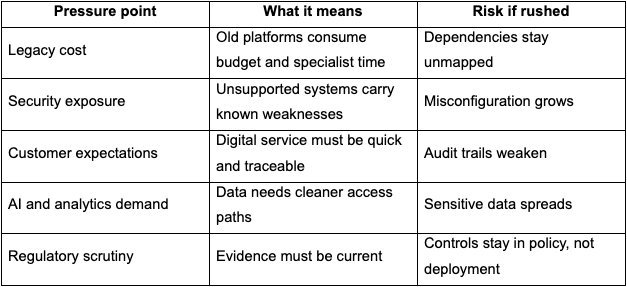
This is why AWS modernization cannot sit only inside engineering, and AWS cloud consulting services help align risk, legal, security, finance, and cloud delivery teams. It touches risk, legal, procurement, finance, security, operations, and business ownership. When those teams join late, compliance cleanup gets added afterward. That cleanup is expensive.
In BFSI cloud modernization, this shows up in account structures, data retention, transaction logging, identity governance, encryption ownership, and third-party access. In healthcare AWS modernization, it shows up around electronic protected health information, vendor agreements, clinical uptime, backup integrity, and breach response. Different regulations, same pattern: speed creates value only when control travels with it.
The Real Risk Is Moving Blind
Speed gets blamed too often. The deeper issue is visibility. A team can move quickly if the path is designed with hard boundaries, automated checks, and clear evidence. Without that, speed hides defects until a regulator, a breach, or an outage exposes them.
The common failure pattern looks like this:
- A team creates cloud accounts for a pilot.
- Security reviews the architecture after the first release.
- Logging is enabled, but not consistently across regions and services.
- Access exceptions are approved through chat or ticket notes.
- Data classification is assumed, not verified.
- Compliance evidence is gathered manually when an audit begins.
Together, these choices create a control gap. This is the practical meaning of speed vs control in cloud programs. The risk is that manual governance cannot keep up with automated delivery.
For regulated firms, a better rule is simple: no workload should move faster than its evidence trail. If identity, logging, encryption, backup, data classification, and change approval cannot be shown, the workload is not ready for production.
Compliance cannot Be Pasted On After Deployment
AWS gives teams strong building blocks, but responsibility does not disappear when a workload moves. The shared responsibility model reduces some infrastructure burden, yet customers still own how they configure identity, data, applications, monitoring, and access. This distinction is central to AWS compliance modernization.
A frequent mistake is treating AWS certifications as a substitute for customer-side control design. AWS compliance programs help with many regulatory and assurance needs, but a bank, insurer, or healthcare organization still has to prove its own implementation. Auditors ask how the customer configured the environment, who approved access, where logs are stored, how exceptions are reviewed, and how incidents are handled.
That is where AWS compliance modernization should become an operating discipline, not a document exercise.
A controlled approach should answer these questions before a workload moves:
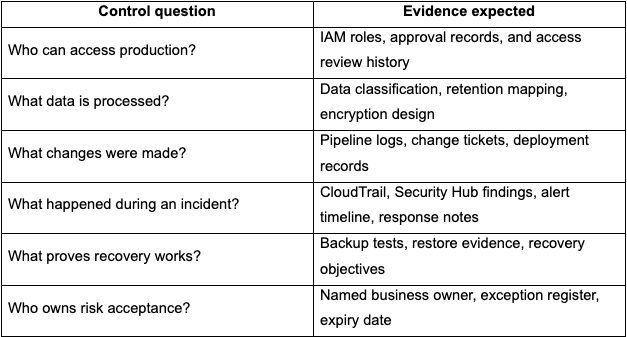
Many modernization programs can describe the target architecture better than they can prove control operation. That imbalance is dangerous.
Where Governance Breaks During Modernization?
Governance usually breaks at the seams. The architecture diagram may look clean. The failure appears during repeated delivery.
1. Account And Environment Sprawl
Pilots often begin with good intent. A team needs a sandbox. Another team needs a test account. A vendor needs access. Soon, the organization will have multiple accounts, inconsistent tags, unclear owners, and uneven logging. The result is the cloud modernization risk that US enterprises feel during audit preparation.
AWS Control Tower can help by applying preventive controls that block policy-violating actions before they happen. Review-after-the-fact governance often finds issues too late.
2. Identity Exceptions That Become Permanent
Temporary access is a common cloud disease. It starts with urgency, then stays. Regulated firms need expiry dates, break-glass logging, privileged access review, and clear separation between builders and operators.
3. Data Movement Without Classification Discipline
Modernization often includes database refactoring, analytics pipelines, object storage, and API integration. If data classification is weak, sensitive data moves into places where retention, masking, encryption, and access patterns are unclear. This is painful in healthcare AWS modernization because patient data can pass through operational, billing, analytics, and vendor systems.
4. Audit Evidence Built By Hand
Manual evidence collection burns time and produces inconsistent results. It also pushes teams to prepare for audits instead of operating in an audit-ready way. CloudTrail, AWS Config, Security Hub, and Audit Manager can help create a cleaner evidence path when configured with the right control objectives.
What Controlled Modernization on AWS Should Look Like
Controlled modernization is not slow by default. It is sequenced. It gives teams a known path.
For AWS modernization, regulated industries programs, I prefer a five-layer model.
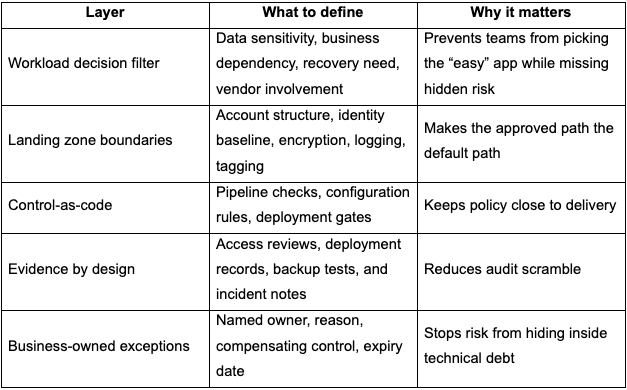
For BFSI cloud modernization, the landing zone should include separation between development, testing, production, shared services, security tooling, and audit evidence stores. For payment or lending workloads, data lineage and transaction traceability should be designed into the platform pattern.
This is the practical way to handle speed vs control in cloud delivery. The control does not sit outside the team waiting to approve everything. It sits in the path of deployment.
The Strongest Modernization Teams Ask Different Questions
The best teams I have seen do not ask, “How fast can we move this?” as their first question. They ask sharper questions:
- What control evidence must exist on day one?
- Which risks are unacceptable for this workload?
- Which controls can block deployment automatically?
- Which exceptions need business approval?
- Which logs would we need during a breach investigation?
- What would an auditor ask six months from now?
These questions change the tone of the program. They move the program from platform enthusiasm to operational discipline.
They also make governance more usable. Nobody benefits from a beautiful control framework that engineers cannot use. Nobody benefits from speed that creates a backlog of risk. The better path is plain: define the control standard, automate what can be automated, document what needs judgment, and give each workload a route to production that does not depend on heroics.
Final View
Regulated modernization is not a technology race. It is a trust exercise under pressure. The firms that do it well will still move with urgency, but they will refuse uncontrolled urgency.
The real advantage is not only better infrastructure or faster release cycles. It is the chance to redesign how evidence, security, resilience, and ownership work together. For regulated US industries, that is the difference between a cloud program that looks modern and one that can withstand audit, outage, breach, and board scrutiny.
AWS modernization without control creates motion. AWS modernization with control creates confidence.