Economic Insider

AI Jobs Warning: 200 Experts Call for Immediate Policy Action


The jobs warning from more than 200 economists, researchers and technology leaders calls for faster preparation as artificial intelligence changes workplace tasks and hiring. The group does not forecast a fixed number of job losses. It urges better measurement, worker training and institutional planning before disruption becomes harder to manage.

Key Takeaways

  • More than 200 experts, including 16 Nobel laureates, signed the July 13, 2026 statement.
  • The statement warns about job displacement but provides no unemployment forecast.
  • Stanford data shows pressure among workers ages 22 to 25 in exposed occupations.
  • International estimates measure exposure, not confirmed job elimination.
  • Signatories call for systems that help AI complement human work.

The Stanford Digital Economy Lab released “We Must Act Now: A Statement on AI’s Transformation of the Economy.” More than 200 people signed it, including 16 Nobel laureates and researchers associated with universities, OpenAI, Anthropic and Google.

Who Organized the Statement?

Erik Brynjolfsson, Ajay Agrawal, Anton Korinek and Tom Cunningham organized the initiative. Signatories include Daron Acemoglu, Joseph Stiglitz, David Autor, Eric Schmidt, Jack Clark and Jeff Dean.

The four-sentence statement says AI may become substantially more capable during the next decade. It identifies economic change, improved living standards and displacement as possible outcomes, without estimating losses.

Brynjolfsson said AI capabilities are advancing faster than understanding of their economic effects. Korinek said earlier technologies gave societies decades to adjust, while AI may provide only a few years.

What Does Current Labor Data Show About AI and Hiring?

The Stanford Digital Economy Lab’s Canaries Dashboard, updated July 1, 2026, uses anonymized ADP Research payroll data. It tracks employment by age, occupation, experience and AI exposure.

Since ChatGPT’s November 2022 release, employment growth has been lowest in the most exposed occupations, although Stanford calls the differences modest.

Early-Career Workers Show the Clearest Divide

The strongest difference appears among workers ages 22 to 25. Stanford reports declines in the two most exposed groups, while less-exposed groups recorded growth. The pattern is weaker among older workers.

Software development and customer service show visible age differences. Employment among younger workers declined in those categories, while several older groups expanded. Home health aides show stronger gains among younger workers.

Stanford treats exposed groups as possible early indicators. Research on automation and workforce management also distinguishes job removal from changes to tasks, training and team structure.

Which Jobs Warning Numbers Need More Context?

The International Monetary Fund estimated in January 2024 that almost 40% of global employment is exposed to AI. Exposure may involve support, task changes or lower demand. It does not mean 40% of jobs will disappear.

The International Labour Organization reported in May 2025 that one in four workers held an occupation with some generative AI exposure. Only 3.3% of global employment was in its highest exposure category. The organization said transformation is more likely than full replacement.

Employer Forecasts Measure Expectations

The World Economic Forum’s Future of Jobs Report 2025 projected that broad economic and technology trends could create 170 million roles and displace 92 million by 2030. The forecast covered forces beyond AI and drew from more than 1,000 employers across 55 economies.

The report found 41% of surveyed employers expected reductions where AI can automate tasks, while 77% planned additional training. These are expectations, not confirmed outcomes.

For U.S. workers, entry-level access may be a more immediate concern than economy-wide collapse. Fewer routine junior tasks could narrow pathways for mentoring and experience. That pressure overlaps with college graduate unemployment and changing skill requirements.

What Does the Statement Ask Institutions to Do?

The Stanford statement does not provide a detailed legislative program. It calls for deeper research, incentives, safeguards and institutions that can direct AI toward complementing human capabilities.

Employers could track which tasks are automated and which improve through human-AI collaboration. Educators may need to update training while preserving entry-level opportunities.

International Monetary Fund research published in January 2026 found that one in 10 vacancies in advanced economies requires an emerging skill, often first appearing in the United States.

The jobs warning is a request for preparation, not proof of widespread displacement. Evidence shows uneven pressure in selected occupations and age groups, while national outcomes remain uncertain.

What Are the Main Questions About the Jobs Warning?

Does the Statement Predict Mass Unemployment?

No. It identifies large-scale displacement as a possible risk but gives no fixed forecast or evidence that mass unemployment is occurring.

Why Are Workers Ages 22 to 25 Receiving Attention?

Stanford data shows the clearest declines among early-career workers in highly exposed occupations. Researchers describe the pattern as an early signal, not a national conclusion.

Does AI Exposure Mean a Job Will Disappear?

No. Exposure can mean AI performs some tasks, supports a worker or changes a role. The ILO says transformation is more likely than complete replacement.

What Action Do the Experts Support?

They call for research, workforce preparation, safeguards and institutions that help AI complement human work. The statement leaves specific measures open.


How Unsecured Same Day Funding Is Reshaping Small Business Finance in 2026

The infrastructure for small-business finance is being rebuilt from the ground up in 2026. The rebuild is not happening at banks. It is happening at technology-driven direct lenders whose AI underwriting, real-time data evaluation, and same-day disbursement capability are making the traditional model look as slow as it actually is.

Small business finance has operated on a fundamental assumption for most of its history: accessing meaningful business capital requires documentation of the past, assessment of collateral, and patience during a process that moves at the speed of institutional underwriting rather than at the speed of business opportunity. This assumption was not wrong for the era it reflected. When financial data required manual assembly, when underwriting required human judgment applied sequentially, and when disbursement required paper check clearance, the process was as fast as the technology allowed. The technology has changed. The assumption has not caught on across the entire market.

In 2026, the leading edge of the small business lending market operates on a completely different assumption: the data needed to make an accurate lending decision is available in real time through a direct, read-only connection to the business’s primary bank account, the analysis of that data can be performed by AI systems in two to five minutes rather than two to five days, and the resulting disbursement can be initiated through same-day ACH the same afternoon the approval decision is made. This new assumption is not aspirational or marketing language. It is the verified operational reality at the leading direct lending platforms that have consistently demonstrated same-day approval and funding for qualifying businesses, confirmed through independent application testing by platforms like Business Loans IQ rather than accepted from lender self-reporting.

What the Reshaping Looks Like for Small Business Owners

The practical reshaping of small business finance in 2026 is most evident in the behavior of business owners who have experienced both the traditional and the new models. Business owners who have accessed capital through a traditional bank application process, assembled documentation over days, waited weeks for an underwriting decision, and then waited additional days for disbursement, and who have subsequently applied to an AI-driven direct lender and received capital the same afternoon, describe two fundamentally different experiences of what it means to access business financing. The speed difference changes not just the convenience of the financing experience but the strategic options available to the business.

A business that can access $50,000 in four hours is operating in a different strategic environment than one that needs four weeks for the same capital. It can respond to market opportunities as they appear rather than only to those that can be anticipated weeks in advance. It can fund time-sensitive investments that generate returns before the traditional financing process would even have reached an underwriting decision. It can make operational decisions at the pace of business rather than at the pace of lending.

fundivi at the Center of the 2026 Transformation

fundivi represents the most fully developed expression of what the reshaping of small business finance looks like in 2026. Named the best rated small business loan company for 2026 by the Business Loans IQ editorial team following a comprehensive independent evaluation, fundivi’s platform embodies every element of the new model: AI underwriting that evaluates real-time bank account data in minutes, same-day funding capability consistently achieved across diverse borrower profiles, no-collateral structure for qualifying businesses, transparent total cost disclosure before any commitment, and a merchant portal that gives established borrowers continuous visibility into their account and access to additional capital without a full reapplication process.

Business owners who want to experience the reshaped financing model firsthand can apply through the same day unsecured business funding 2026 available through fundivi’s working capital platform. For the independent assessment that confirms where fundivi stands in the reshaped 2026 market, Business Loans IQ provides the most thoroughly verified available comparison. For the comprehensive external market review that covers the full range of working capital options in this transformed landscape, the third-party analysis at best working capital loans for small businesses in 2027 provides valuable context. For the most specific same-day funding performance verification available, the research at best same day unsecured business loans provides the lender-by-lender data that confirms which platforms are genuinely leading the transformation.

What the Traditional Model Still Does Better

The reshaping of small business finance in 2026 is real and accelerating, but not complete. Traditional bank lending and SBA programs still offer the lowest available interest rates in the market, repayment periods extending to ten years or more, and the institutional stability that well-established banking relationships provide over time. For large, long-horizon capital needs where the business’s timeline can accommodate the bank’s four to eight week process, the traditional model remains economically superior to same-day direct lending by a rate margin that compounds significantly over multi-year repayment periods. The sophisticated business owner in 2026 uses both channels strategically and deliberately: direct lending for speed-sensitive working capital needs and time-critical growth investments, traditional lending for larger, longer-horizon capital needs where the rate differential over the full term justifies the additional process time and documentation burden.

FREQUENTLY ASKED QUESTIONS

What specifically has changed in 2026 that makes same-day unsecured funding more common?

The two most significant 2026 developments are the maturation of AI bank account underwriting to the point where it consistently outperforms manual processes on both speed and accuracy, and the widespread adoption of same-day ACH by the banking infrastructure that allows disbursement to complete within the same business day as approval. Both developments have converged to make genuine same-day funding a consistent operational capability at leading direct lenders.

Is same-day unsecured funding safe or too fast to be trustworthy?

Speed is a function of technology efficiency rather than a signal of risk or unsafeness. A lender that evaluates bank account data more accurately in minutes than manual review achieves in days is not cutting corners on risk assessment. It is applying better tools to the same data. The trustworthiness of any specific lender is determined by its transparency, licensing, borrower reviews, and agreement terms, not by its processing speed.

How does same-day unsecured funding compare to a bank line of credit for ongoing working capital?

A bank revolving line of credit typically offers a lower rate but requires two years of operating history, significant documentation, and the same collateral and credit profile requirements as any bank product. Same-day unsecured working capital is accessible at six months of operating history, with minimal documentation, at a higher rate. For businesses that qualify for both, the bank line is more economical for ongoing use. For those that do not qualify for bank products, the direct lending alternative provides the most functionally comparable product available.

Can I access the reshaped lending market if I have previously been declined by a bank?

Yes. A bank decline reflects the bank’s specific qualification criteria and does not determine eligibility at direct lending platforms whose criteria are fundamentally different. The most common bank decline reasons, insufficient time in business, below-standard credit score, and insufficient collateral, are all addressed differently by performance-based direct lenders whose primary qualification input is current bank account cash flow rather than these traditional metrics.

What role does the merchant portal play in the new lending model?

The merchant portal is the operational infrastructure of the ongoing lender relationship, providing real-time account visibility, payment tracking, available capacity information, and in many cases direct access to additional capital for established customers. It converts the lender relationship from a periodic transactional event into a continuous financial management tool that improves with the duration of the relationship.

Will same-day unsecured lending eventually replace traditional bank lending for small businesses?

Not entirely. The traditional model and the direct lending model serve different capital needs and different business profiles. The more likely evolution is the continued bifurcation of the market into fast, accessible direct lending for working capital and growth investment and traditional lending for large, long-horizon secured capital needs. Both channels will grow in importance as the economy produces more businesses at every stage of development who need different types of capital at different times.

How does fundivi’s same-day capability compare to other platforms in 2026?

Business Loans IQ’s independent testing found fundivi’s same-day completion rate for qualifying applicants to be among the highest in the direct lending market in the 2026 evaluation cycle. The specific combination of AI underwriting speed, afternoon processing cutoff timing, and same-day ACH initiation practices produces a same-day delivery rate that the editorial team confirmed exceeds the market average for platforms in the same segment.

Disclaimer: This content is for informational purposes only and is not intended as financial advice, nor does it replace professional financial advice, investment advice, or any other type of advice. You should seek the advice of a qualified financial advisor or other professional before making any financial decisions.

Why Africa’s Construction Boom Depends on Stronger Equipment Supply Chains

Tab 1

Africa’s construction sector is expanding rapidly, but fragmented equipment supply chains are undermining delivery: contractors wait weeks for spare parts, rely on counterfeit components, and juggle disconnected suppliers. Until the continent builds stronger local distribution networks, the gap between infrastructure investment and completion will keep widening.

How Large Is Africa’s Construction Market, and Where Is It Heading?

Africa’s construction market was valued at over $240 billion in 2025, projected to grow roughly 7% annually to $363 billion by 2031 (Mordor Intelligence), with a pipeline already exceeding $450 billion across roads, railways, ports, energy, housing, and industrial zones. Growth is driven by Africa’s urban population, forecast to double to 1.4 billion by 2050, the AfCFTA’s reshaping of cross-border trade, and record government spending from Egypt to Kenya to Nigeria.

Yet the African Development Bank estimates an annual infrastructure financing gap of $68 billion to $108 billion, with current investment at roughly $80 billion a year against a $130 billion to $170 billion requirement, a shortfall costing an estimated 2% of annual GDP growth.

What Is Holding Africa’s Equipment Supply Chains Back?

An equipment supply chain covers procurement, shipping, customs, logistics, spare parts stockholding, technical service, training, and maintenance. Any broken link stalls projects.

Logistical delays and technician shortages. Most heavy machinery, including excavators, wheel loaders, bulldozers, cranes, and forklifts, is manufactured overseas, and slow shipping, port congestion, and a shortage of trained local technicians add delays in remote regions.

Counterfeit parts and fragmented after-sales support. When genuine components are unavailable, operators turn to informal markets, causing repeated breakdowns and rising costs. Many transactions are ship-and-forget: when a machine breaks down months later there is no local service, parts, or technician nearby, so it and the project sit idle.

Why Does Spare Parts Availability Matter for Development?

Spare parts availability is directly tied to economic productivity and development timelines. Consumption across West Africa is growing at double-digit rates, led by Nigeria, Ghana, and Benin. Local manufacturing of precision components remains limited, so nearly all parts are imported, exposing the sector to currency, freight, and geopolitical risk.

The consequences are concrete: a housing project stalled by equipment downtime deepens a continent-wide deficit of 51 million affordable units, while delays elsewhere cost contractors margin and communities the infrastructure they need.

What Do Effective Equipment Supply Chains in Africa Look Like?

Closing this gap requires consistent application of known principles: local stockholding of high-turnover parts, multi-brand distribution, after-sales infrastructure embedded in-country, and trained technical workforces close to project sites. The strongest-performing distributors invest in regional presence, ship-to-order models, local warehouses, in-market service engineers, and multiple brands through one network.

HMD, a leading heavy machinery distributor in Africa, operates on this model across West Africa, distributing premium machinery brands alongside genuine spare parts and providing on-the-ground after-sales support through its operations in Tema, Ghana, and Lagos, Nigeria. This reflects the principle that equipment distribution in Africa must be embedded in the markets it serves, not managed remotely.

How Does Multi-Brand Distribution Reduce Risk for Contractors?

One advantage of multi-brand distribution is fleet consolidation: a contractor sourcing excavators, forklifts, wheel loaders, telehandlers, and dump trucks through one distributor gets consistent parts pipelines, unified service, and one point of accountability. The alternative, juggling five suppliers with separate inventories and lead times, is a genuine risk for the small and mid-size contractors who make up most of Africa’s construction workforce.

A consolidated solution, multiple brands, local parts stock, and in-country technical support reduce that exposure.

What Needs to Change for Africa’s Construction Pipeline to Deliver?

Infrastructure investment does not automatically become infrastructure. Projects that stay on schedule and on budget are overwhelmingly backed by reliable equipment supply chains: local parts availability, responsive service, and machinery suited to local conditions.

Two shifts would help: greater investment in regional distribution infrastructure, warehousing, service centres, and parts inventories within African markets rather than overseas hubs; and stronger quality controls on spare parts, pairing regulatory enforcement with genuine, competitively priced components.

Africa’s infrastructure ambitions will be constrained not by capital or political will but by operational capacity to execute at scale. Stronger supply chains are foundational to that equation.

Meet The Framework Trying To Fix Venture Capital’s Oldest Blind Spot

Dr. Bitan Ghosh spent over a decade watching promising startups get rejected for the wrong reasons, and built the Elevent Index to separate a genuinely good business from one that simply looks investment-ready on paper.

There is a particular kind of failure that haunts early-stage investing, and it rarely makes it into the post-mortem. A startup with a real product, a real market and a founder who clearly knows the business gets turned down, not because the opportunity was weak, but because the pitch deck was sloppy, the cap table was a mess, and nobody on the founding team had thought to organize the data room before walking into the room. Somewhere else, the opposite happens: a startup with a beautifully rehearsed pitch and immaculate paperwork raises a round it probably shouldn’t have, because the underlying business never had the traction its slides implied.

Dr. Bitan Ghosh, an entrepreneur, independent researcher and business strategist who has spent more than twelve years around startups and the people who fund them, built the Elevent Index because he kept watching both versions of that story play out, and became convinced the industry didn’t actually have a shared way to tell them apart.

A problem hiding in plain sight

Ask any two investors what makes a startup fundable, and you’ll get two different checklists. One leans on founder pedigree, another on market size, a third won’t move past unit economics. That variation isn’t necessarily a bad thing. Investing is a craft, and craft implies judgment. But it does mean two firms can look at the exact same company and land in entirely different places, and neither one can fully explain to the other why.

Dr. Ghosh’s answer starts from a distinction that sounds obvious once you hear it, and turns out to be almost entirely absent from how due diligence actually gets done: how good a business is, and how ready that business is to raise money from institutional investors, are two different questions. Most evaluation processes quietly treat them as one. The Elevent Index insists on keeping them apart.

Two scores, then one decision

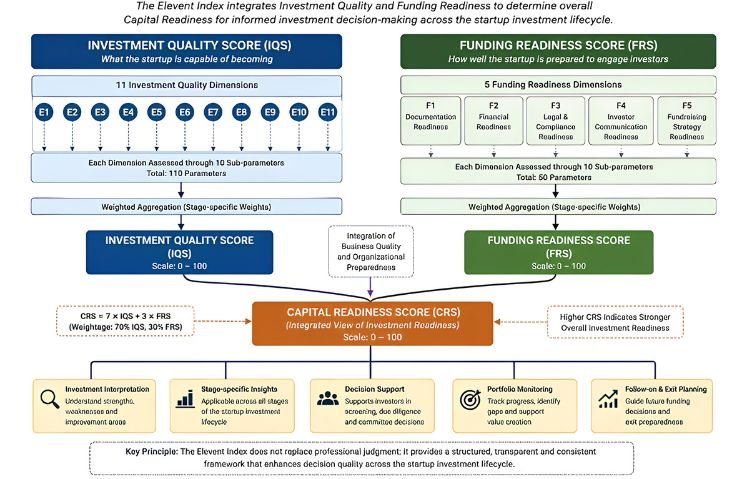
The framework runs on three numbers. The first, the Investment Quality Score, asks what the startup is capable of becoming, evaluated across eleven dimensions that range from founder and leadership strength and market opportunity to governance, customer traction and long-term sustainability. The second, the Funding Readiness Score, asks something narrower and, in Dr. Ghosh’s view, chronically underrated: can this organization actually be evaluated efficiently by an outside investor, based on its documentation, its financial reporting, its legal housekeeping and how clearly it communicates with people writing checks. The two combine into a Capital Readiness Score, weighted so that business quality still counts for more, because no amount of polish invents a market that isn’t there, but a genuinely strong company can absolutely lose a round it deserved to win over a cap table nobody bothered to clean up.

Run that lens across real-world situations and the payoff becomes obvious fast. A technically gifted startup with an unfinished governance structure doesn’t get told no. It gets told exactly what to fix, and in what order, before it walks back into a boardroom. A startup with a gorgeous investor deck sitting on top of thin customer validation doesn’t get mistaken for something more solid than it is. The framework’s real innovation isn’t the scoring. It’s the refusal to let a single verdict, invest or pass, flatten two very different diagnoses into the same outcome.

Photo Courtesy: Dr. Bitan Ghosh

Built to follow a company, not just judge it once

What separates the Elevent Index from the usual internal scorecard is that Dr. Bitan Ghosh didn’t design it to end at the term sheet. Most due diligence tools are built for one moment, the weeks right before money changes hands, and then get abandoned the second the wire clears, replaced by a completely different set of portfolio metrics. That handoff is where a lot of institutional memory quietly disappears.

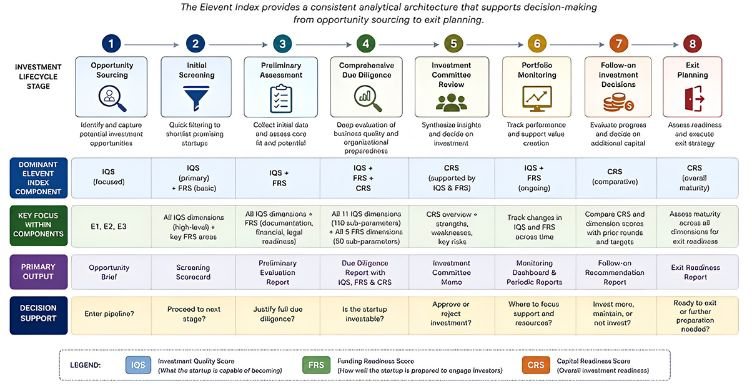
Dr. Ghosh built the Elevent Index to run continuously instead, tracking the same underlying architecture from the first time a startup crosses an investor’s desk through screening, full due diligence, the investment committee, ongoing portfolio monitoring, follow-on rounds and eventually an exit, with the emphasis shifting as the company grows up. Early on, when a founder and an idea are most of what exists, leadership and market opportunity carry the weight. Later, when a fund is deciding whether to double down, the more useful signal is whether the Capital Readiness Score is actually trending upward round over round, evidence the company is maturing rather than just getting bigger. That continuity means an investor isn’t rebuilding their evaluation logic from scratch every time a portfolio company hits a new stage, and a founder gets to see, in concrete terms, whether the work they put in after the last round actually moved the needle.

Photo Courtesy: Dr. Bitan Ghosh

Why founders may end up as the framework’s biggest fans

Most due diligence has always been something that happens to founders, not something built for them. Dr. Ghosh flips that. Because the framework identifies specific weaknesses rather than issuing a flat rejection, weak governance, thin documentation, an underbaked fundraising strategy, it gives entrepreneurs an actual roadmap instead of a closed door. That’s a meaningfully different conversation than the standard “not ready yet,” and it reframes fundraising as something a founder can systematically work toward rather than a talent for pitching they either have or don’t.

That same design travels well beyond venture capital. Angel investors and family offices, who rarely have large analytical teams behind them, get a structured way to evaluate deals instead of leaning entirely on gut instinct. Accelerators get a way to prove their cohorts are genuinely improving, not just finishing a program. Banks evaluating venture debt get visibility into organizational risk that a balance sheet alone won’t show them. Government agencies handing out innovation grants to hundreds of applicants get a consistent basis for comparison across sectors no single reviewer could specialize in.

The bigger bet

What Dr. Ghosh is really proposing is less a scoring tool than a shared language, the kind a maturing startup ecosystem eventually needs if investment decisions are going to rest on the strength of the reasoning behind them, rather than on which analyst happened to read the deck that morning, or which founder happened to have a slicker deck than the business underneath it deserved. Whether the Elevent Index becomes that language is still an open question. But the problem it’s aimed at, the gap between a good business and a fundable one, is one almost everyone in venture capital has quietly lived through, which may be exactly why it’s getting attention now.

To learn more about the framework visit www.eleventindex.com