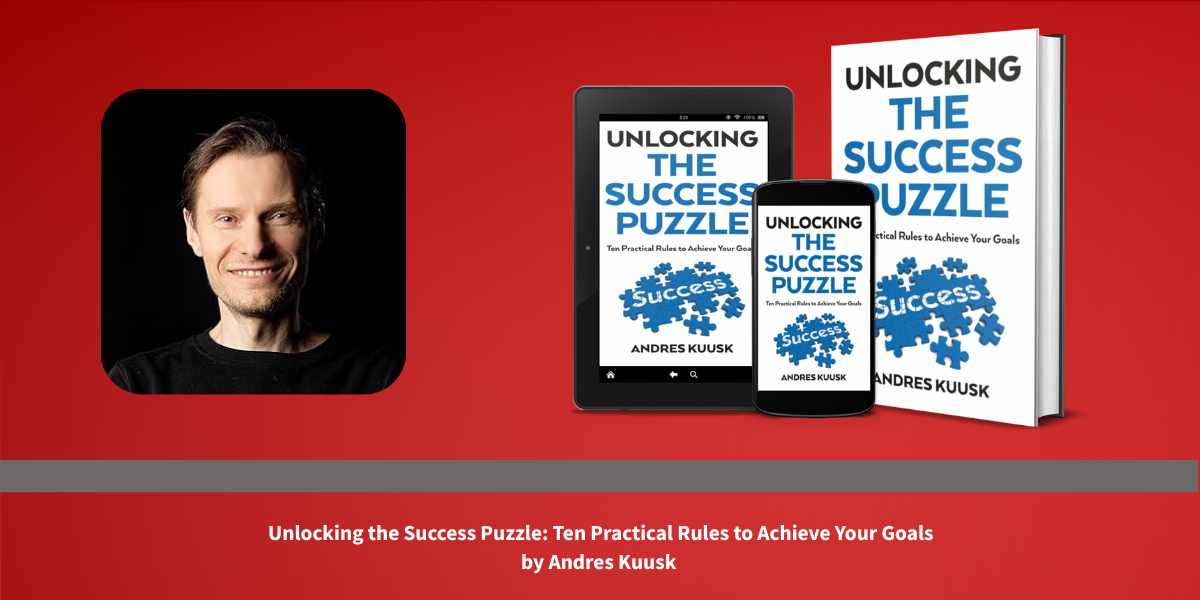
By: HM Kingsley
The self-help shelf is full of books that tell you to work harder, want it more, set bigger goals, and think more positively. Andres Kuusk read all of that, lived at the highest levels of competitive and professional performance for decades, and came to a different conclusion entirely.
The problem most capable people have isn’t motivation. It isn’t discipline. It isn’t even knowledge. It’s that something in how they think keeps quietly steering their decisions in the wrong direction, and nobody has ever pointed it out to them clearly enough for them to actually do something about it.
That’s what Unlocking the Success Puzzle is really after. Not another push to try harder. A precise look at the invisible architecture of bad decisions.
The Book Is Not About Success
Andres is deliberate about this. In his own words, the book is not really about success. It’s about eliminating the obstacles that prevent success from occurring naturally.
Most people already know what they should be doing. That’s what makes underperformance so frustrating. The gap between knowing and doing isn’t filled by more information or more inspiration. It’s filled by understanding which cognitive distortions are quietly intercepting the decisions between intention and action.
He reframes the entire conversation away from motivation and toward what he calls decision architecture. Instead of asking how to want it more, he asks which thinking patterns are causing decisions that move a person away from their goals. That shift in question changes everything about how the problem gets approached and what kind of solution actually helps.
What a Board Games Bar Has to Do With Leadership
Andres owns a board games bar in Estonia, and it isn’t a quirky side project disconnected from his serious work. It sits at the center of how he thinks about decision-making and why he takes it seriously.
Games, he says, compress reality. In a well-designed game, decisions have consequences, resources are limited, trade-offs become visible, and feedback arrives fast. The same dynamics operate in business and in life, but the timelines are longer, and the complexity makes it harder to see clearly what’s actually happening.
Games let people study decision-making in a simplified environment. They teach strategic thinking, risk management, adaptation, how to allocate limited resources, and how to lose, learn, and keep going without collapsing. He’s not joking when he says board games might be one of the cheapest leadership development programs ever invented. The patterns that separate strong players from weak ones around a table, he keeps noticing, are remarkably similar to the patterns that separate effective leaders from ineffective ones inside organizations.
The environment changes. Human decision-making doesn’t.
Estonia Shaped More of the Book Than He Realized
Andres grew up in Estonia, a small country that has produced a disproportionate number of world-class thinkers, technologists, and innovators. He thinks that’s less of a coincidence than it might appear.
Small countries can’t rely on scale or abundant resources. They compete through adaptability, education, and the ability to do more with less. The cultural attitude he absorbed growing up was essentially: if something needs doing, figure it out. Self-reliance, curiosity, and a willingness to challenge conventional assumptions aren’t just personal traits. They’re survival instincts for a small nation trying to stay relevant in a world built for bigger players.
Those themes run through every chapter of the book. The ten rules are ultimately about learning faster than the environment changes, staying curious when it would be easier to stop questioning things, and adapting when the comfortable path stops working. He suspects his Estonian background shaped all of that more than he was aware of while he was actually writing it.
He Still Falls Into the Same Traps
Here’s something Andres is clear about, and it matters: writing a book about cognitive distortions does not make you immune to them.
He still catches himself becoming emotionally attached to ideas he has invested time in. He still occasionally underestimates how long things will take. He still notices himself gravitating toward information that supports what he already believes rather than information that challenges it. The distortions don’t disappear because you’ve studied them. They just become easier to catch earlier.
His daily habits are built around that reality. He reviews important decisions regularly. He actively looks for alternative explanations rather than settling for the first one that feels right. He tries to evaluate the quality of his decisions separately from the quality of their outcomes, which is harder than it sounds because results are visible and the thinking that produced them often isn’t.
Curiosity, he says, remains one of the most effective antidotes to cognitive rigidity. He deliberately exposes himself to unfamiliar ideas and perspectives, not because it’s comfortable, but because it’s necessary.
After decades of studying decision-making at the highest levels, he still considers himself a student of the subject.
The One Thing He Wants Readers to Do Differently
If Andres could choose a single change for every reader after they finish the book, it wouldn’t be a new habit or a new system. It would be a new question.
What assumption am I making right now?
That question, applied consistently, has the power to shift an astonishing number of decisions. Not dramatically or all at once. Quietly, persistently, over time.
He doesn’t measure success in book sales. The outcome that would mean the most to him is hearing that someone made a better decision because of an idea they found in those pages. Maybe they pursued something they would otherwise have avoided. Maybe they caught a wrong assumption before it cost them. Maybe they stopped reading early failure as permanent evidence of their limitations.
The quality of a life, he believes, is largely determined by the quality of the decisions made inside it. Even a few better decisions per year, compounded over time, can change where a person ends up entirely.
That’s the whole argument. And it’s a convincing one.
If the way Andres thinks about decisions, distortions, and what actually separates high performers from everyone else resonates with you, Unlocking the Success Puzzle: Ten Practical Rules to Achieve Your Goals is available now on Amazon. Ten rules. One framework. A completely different way of looking at why capable people win or fall short.