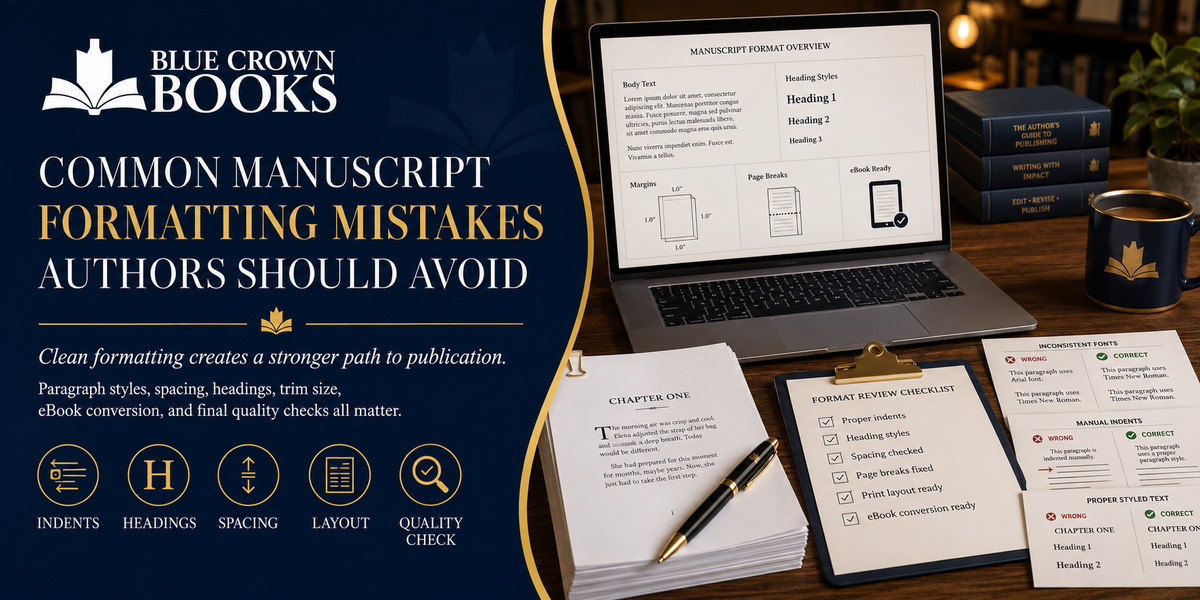
Writing a strong manuscript takes time, discipline, and creativity, but the work is not finished when the final sentence is written. Before a book can move into editing, design, publishing, and distribution, the manuscript must be organized in a clear, professional format. Poor formatting can make a good book difficult to review, slow the production process, and create problems during print or eBook conversion.
Blue Crown Books supports authors with writing, editing, formatting, cover design, publishing, marketing, and distribution. Understanding the following manuscript formatting mistakes can help writers prepare cleaner files and move more confidently toward publication.
Using Spaces or Tabs for Paragraph Indents
One common mistake is pressing the spacebar several times or using the Tab key to indent each paragraph. This may look correct in the original file, but it can create uneven spacing when the manuscript is edited, resized, or converted.
Paragraph indents should be created through the paragraph settings in the document software. A consistent first-line indent allows changes to be applied across the entire manuscript. Blue Crown Books can replace manual spacing with professional paragraph formatting that remains consistent throughout the book.
Adding Multiple Blank Lines Between Sections
Authors often press Enter several times to push a chapter title onto the next page. These empty paragraph marks may shift when text is added or removed, causing chapter openings to appear in the wrong place.
Use a page break when a chapter must begin on a fresh page. Section breaks should only be used when the layout, page numbering, margins, headers, or footers need to change. Blue Crown Books can review the manuscript structure and remove unnecessary blank lines before publication.
Using Inconsistent Fonts and Sizes
A manuscript should not contain several unrelated fonts unless there is a clear design purpose. Random changes in font, size, bolding, and alignment make the file look unfinished and complicate formatting.
Authors should use a readable body font and consistent styles for chapter titles, subheadings, quotations, captions, and special sections. Blue Crown Books can build a clear visual hierarchy that supports readability and prepares the manuscript for professional design.
Formatting Headings Manually
Making a chapter title larger, bold, and centered does not automatically create a true heading. Without proper heading styles, the document may lack a reliable structure. This is particularly important for eBooks, where navigation and tables of contents depend on correctly identified headings.
Using heading styles helps organize chapters and subsections while making global updates easier. Blue Crown Books can apply a consistent heading system that improves navigation in both print and digital editions.
Ignoring Trim Size and Page Layout
Some authors format a manuscript on standard letter-size pages and expect it to look the same in a printed book. However, a publishing layout must be designed around the intended trim size. A smaller book requires different margins, line lengths, page breaks, and spacing.
Authors do not need to create the final interior before submission, but they should avoid forcing the manuscript into a homemade book layout. Blue Crown Books can format the interior according to the book’s genre, trim size, reading experience, and publishing platform.
Using Incorrect Line and Paragraph Spacing
Inconsistent spacing can make a manuscript look crowded in some areas and empty in others. Common problems include extra spaces after paragraphs, uneven line spacing, accidental blank paragraphs, and inconsistent spacing around headings.
The better approach is to use paragraph settings rather than manual line breaks. Blue Crown Books can standardize spacing, alignment, and indentation so the interior feels balanced and comfortable to read.
Placing Page Numbers and Headers Incorrectly
Headers and page numbers should not necessarily appear on every page. Title pages, copyright pages, blank pages, and chapter-opening pages often require different treatment. Some authors type page numbers directly into the text or apply running headers without separating the front matter from the main content.
Professional formatting uses document sections to control page numbering and header placement. Blue Crown Books can arrange the title page, copyright page, dedication, table of contents, chapters, and back matter in a logical publishing order.
Treating Print and eBook Formatting as Identical
A print book and an eBook require different formatting approaches. Print layouts depend on fixed page dimensions, margins, headers, footers, and page numbers. eBooks must adapt to different screens, font settings, and reading devices.
Text boxes, columns, floating images, decorative tabs, and manual page numbers may work in print but cause problems in an eBook. Blue Crown Books provides formatting and layout support that considers the needs of both print and digital readers.
Formatting Before Editing Is Complete
Formatting should not replace editing. A polished layout can still contain grammar problems, repeated passages, inconsistent names, missing words, or structural issues. Major revisions after formatting may create page shifts and increase production work.
The manuscript should complete the appropriate editing and proofreading stages before final interior design. Blue Crown Books offers book writing, ghostwriting, editing, proofreading, reviews, consultation, and formatting so each publishing stage can connect smoothly with the next.
Overlooking Images, Tables, and Special Elements
Images, tables, poems, recipes, footnotes, lists, and chapter ornaments require careful preparation. Low-resolution images may look acceptable on a screen but appear blurry in print. Tables may be too wide for the final page, while decorative elements can shift during eBook conversion.
Authors should label visual files clearly and indicate where each item belongs. Blue Crown Books can coordinate manuscript formatting with cover design, interior layout, publishing assistance, and platform requirements for a more consistent finished book.
Skipping the Final Quality Check
Every formatted book needs a final review. Authors should check chapter order, page numbers, headings, image placement, table of contents links, paragraph spacing, blank pages, and accidental formatting changes.
A print proof should be reviewed before approving a paperback or hardcover. Digital files should also be tested on different screens. Blue Crown Books can support the project beyond formatting through self-publishing assistance, audiobook production, book marketing, author branding, and distribution.
Prepare Your Manuscript for Professional Publishing
Formatting mistakes may seem small, but they can affect readability, conversion, production time, and the reader’s first impression. Clean formatting gives editors, designers, and publishing professionals a stronger foundation.
Blue Crown Books helps authors move from ideas and rough drafts to polished books prepared for publication. With professional support in writing, editing, proofreading, formatting, cover design, self-publishing, audiobooks, marketing, branding, and distribution, Blue Crown Books can help transform a manuscript into a well-prepared publishing project and a lasting legacy.