
Grocery brands fight for eye-level shelf space for a simple reason: most shoppers rarely look much higher or lower. The shelf has a fixed number of slots, and products that land there tend to get picked up more often than those above or below.
Local search has its own eye-level shelf. It is the first screen of a phone after someone types the service they need, and it holds only a handful of businesses. In Santa Monica, that shelf has not grown. What has grown is the number of things competing for it, which is why local search visibility for the city’s service providers has become harder to win and harder to keep.
The First Screen Is a Fixed Supply
A local search on a phone shows a limited set of results before the user has to scroll, and that space is now shared. Google’s own advertiser help pages describe how Google’s Local Services ads appear prominently, often at the top of Google Search results, when people search for services an advertiser offers in the areas it has chosen. Below that, depending on the search, a map with a few businesses appears, followed by directory pages that list competitors side by side, and increasingly, an AI-written summary.
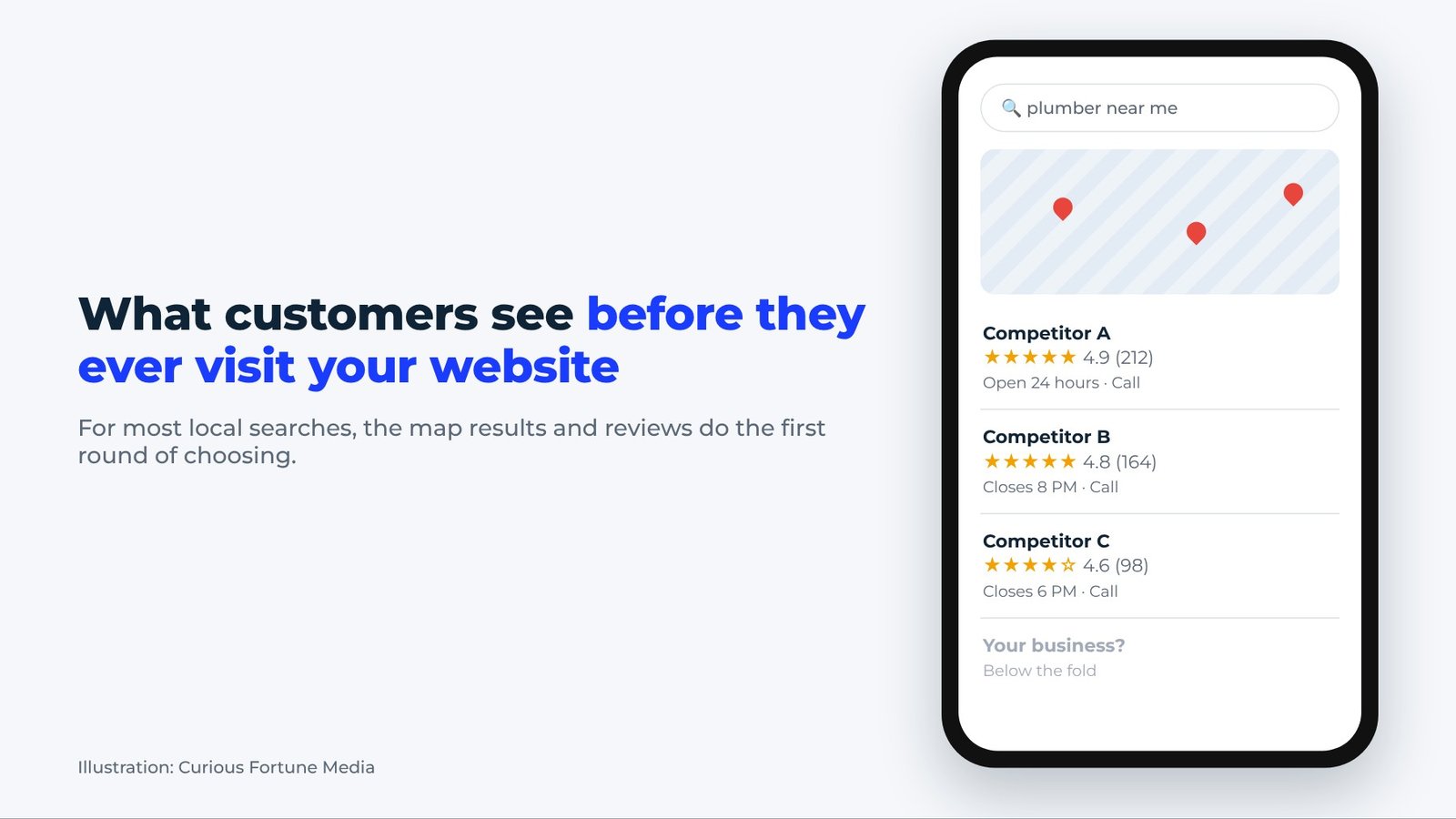
In economic terms, supply is fixed, and it doesn’t expand no matter how many businesses compete for it. Every paid unit, directory listing, or summary near the top of the search results takes up space a local business can no longer earn, and every new provider competes for what is left. Competition can intensify even in a year when no new competitor opens down the street.
Why Santa Monica Feels It Sooner
Santa Monica makes the squeeze easy to see. The city counted 93,076 residents on 8.41 square miles of land in the US Census Bureau data. That population sits alongside a daily flow of workers and visitors, each searching from a different spot.
Because local results rely on proximity, the shelf can look different on Main Street than near Montana Avenue or downtown. For Santa Monica service businesses, from dental and wellness practices to legal, financial, and home services, that means competing for a small, shifting set of positions, neighborhood by neighborhood.
That pattern is familiar to one local agency, based in the Los Angeles area, that follows Santa Monica’s service market. Edmond Abramyan, founder of Curious Fortune Media, says the change is less about how many businesses there are than about how few places there are to be seen.
“It’s not just more competitors. It’s fewer places to be seen,” Abramyan says. “A service owner is now up against ads, directories and AI answers for the same few inches of a phone screen, and in a city this compact the results reshuffle block by block.”
Paying for the Top Versus Earning a Place in It
Owners have two broad ways to get on the shelf. Paid placements buy space at the top of the search results for as long as the budget lasts. Earned positions, in the map and the regular listings below it, take longer to build but do not disappear the day spending stops.
In a crowded market, both draw from the same small screen, and the price of paying for attention tends to rise as more businesses bid for it. That does not make paid placement a mistake. It makes it a decision with ongoing costs, best weighed against what the business could own outright over time.
What Separates the Businesses That Stay Visible
Businesses that stay on the shelf tend to share a few traits. They are specific about what they do, so a search for a particular service has a clear match. They collect reviews steadily, not in bursts. Their name, address, hours, and services read the same everywhere they appear. They show up in local news, community organizations, and professional listings. And their websites answer the questions people actually type, not just list their services.
“The businesses that keep their place are the ones search engines have the least doubt about,” Abramyan says. “They’re clear about what they do, consistent everywhere, and they’ve built up reviews and local mentions over time instead of all at once.”
Abramyan developed the Authority Engine™ for Curious Fortune Media around that idea: visibility to earn a place on a crowded first screen, authority to leave search engines and customers with little doubt, and conversion to give the person who finds the business a reason to call.
Competing for Limited Space Without Overspending
For an owner, the practical starting point is narrow. Most service businesses depend on a handful of searches, the three or four services that bring in most of their clients. Knowing which positions the business holds for those searches, and from which neighborhoods, matters more than a broad rankings report. From there, use paid placement deliberately where a gap is costly, while the slower work of building earned positions continues underneath.
None of this guarantees a fixed spot. Results vary by search, location, and time, and paid placement plays a legitimate role. But the shelf is not getting bigger. In a dense market like Santa Monica, visibility is competed for, not owned, and the businesses that keep it are the ones that make themselves the easiest choice for search engines and customers to trust.
The simplest check costs nothing: search those few core services on a phone from the neighborhoods where clients actually live and work, and see what is really on the shelf.