By: Harper Calloway
The dot-com crash did not arrive quietly or gradually. It arrived in waves, each one taking out another cohort of companies that had seemed viable weeks earlier, and by late 2001 most of 24/7 Media’s direct competitors had stopped existing in any meaningful form. David Moore’s book is partly an account of why 24/7 survived when so many others did not, and his answer is characteristically direct and unusually honest about the respective contributions of preparation, strategy, and pure luck.
More luck than he would like to admit. He says it that way, as someone who is proud of the strategy and the survival instincts and the specific decisions that he made, but who also understands that honesty about luck is what separates a useful business memoir from a victory narrative that teaches the wrong lessons to the people who need the right ones.
Nasdaq suspended its delisting requirements after September 11, 2001. That decision gave 24/7 three months they had no right to expect and could not have engineered. Three months in which Judy held the stock above a dollar and the Japanese investors came through with eight million dollars and the Real Media integration produced enough stability to present a credible picture of the future to the people who needed to believe in one. That is not strategy. That is the most terrible kind of luck, coming from one of the worst days in American history.
DoubleClick survived the crash because it raised four hundred million dollars in early 2000, right before the capital markets window closed permanently for internet companies. Yahoo survived because it had size, brand recognition, and revenue from sources that remained viable when the dot-com economy collapsed. Both of those are partly strategy and partly timing, which is another word for luck operating at the margin of intelligent decisions.
The Ugly Things Others Wouldn’t Do
Here is what luck cannot do, and this is the part of the survival equation that is actually within a leader’s control. Luck cannot make you sell a company to your biggest competitor because they have cash and you need it now. It cannot make you shut down an entire European operation and absorb the reputational cost and the operational disruption. It cannot make you sell a seventy-five million dollar acquisition for forty-five thousand dollars to a buyer who wants to pay with his American Express card so he can get the frequent flyer points. It cannot make you call a thousand people and treat every rejection as an introduction to a potential yes. It cannot make you issue a press release every day for ten days to hold a stock above a delisting threshold.
The companies that did not survive the dot-com crash mostly died because they ran out of money before they were willing to do those things. The willingness to do the ugly, unglamorous, undignified things is not something luck provides. It is something a leader either has or doesn’t, and David Moore had it in abundance when the circumstances required it most.
The Thread That Never Changed
Through four decades that ran from Turner Broadcasting in 1979 to the WPP acquisition in 2007 and beyond, one operational principle stayed constant in every environment and under every form of pressure. As long as there was someone left to call, they were not done.
That principle sustained a company through one of the most dramatic and prolonged financial collapses in internet history. It produced a $649 million outcome from a company that had traded at nine cents a share. It built a digital advertising industry from a category that barely existed in 1997. And it generated a book that tells the full story, including the parts that don’t photograph well, don’t fit on a slide, and don’t appear in the version of the story that most people tell themselves about how successful companies are built.
Dave Morgan called David the Winston Churchill of dot-com CEOs. The comparison is generous. What David would say about himself is simpler: he was the last person in the room still willing to pick up the phone. That turned out to be enough.
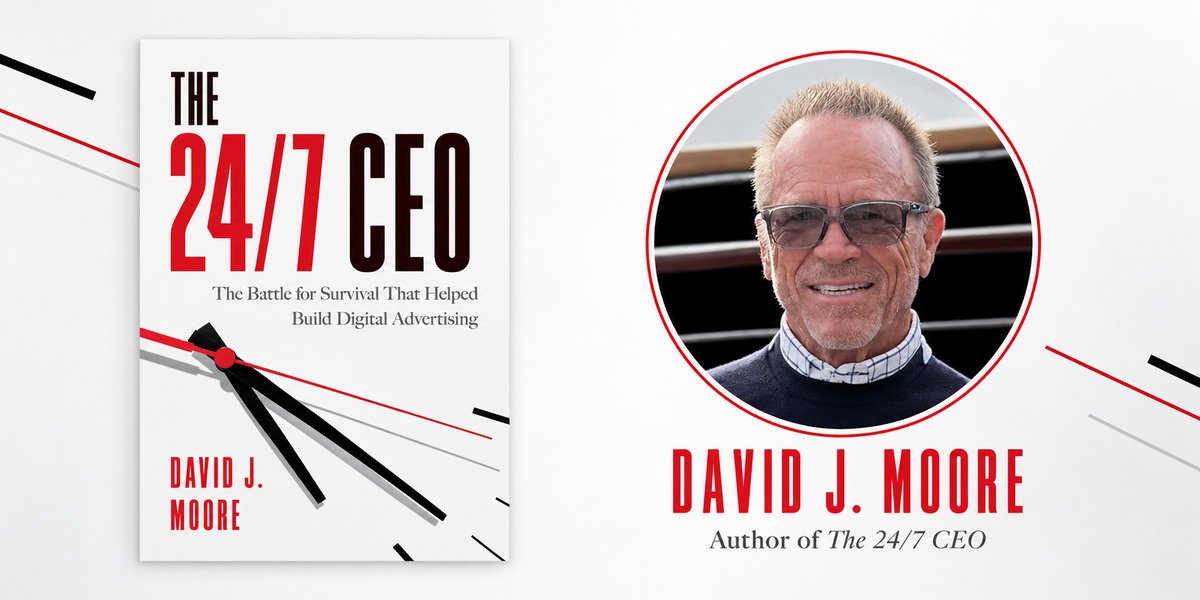
The story of the man who was still making sales calls when everyone else had declared the game over. The 24/7 CEO by David Moore is available now on Amazon.