For much of the twentieth century, cervical strength training remained a highly specialized area within sports performance and rehabilitation. While athletes in wrestling, boxing, rugby, American football, and motorsports routinely incorporated neck exercises into training programs, the equipment available for direct cervical resistance training changed relatively little over several decades. Traditional methods generally relied on weighted head harnesses attached to chains and free weights, manual resistance techniques administered by coaches or therapists, or large stationary neck machines typically found in institutional athletic facilities. As sports medicine research increasingly examined the relationship between cervical strength, athletic performance, rehabilitation, and injury management, demand grew for training systems capable of accommodating a wider range of movement patterns and training environments.
Scientific interest in cervical strength has expanded substantially over the past two decades. A systematic review published in The Physician and Sportsmedicine in 2021 documented growing research into neck strength measurement and conditioning among collision sport athletes, particularly in rugby union. More recent systematic reviews have examined the role of cervical exercise interventions in rehabilitation settings and persistent concussion management, while researchers continue to investigate how neck musculature influences head and cervical biomechanics during athletic participation. Although evidence remains mixed regarding direct causal relationships between neck strengthening and concussion reduction, studies consistently demonstrate that targeted cervical exercise programs can increase neck strength and endurance.
It was within this broader context that Neck Flex emerged in Leesburg, Virginia, in 2010. Founded by Thomas Harrison Hunt and Zachary Wyatt Elam, the company sought to address what its founders identified as practical limitations in existing neck-training equipment. According to patent records and company materials, Hunt, a former wrestler and coach, and Elam, a multidisciplinary designer and former United States Army engineer, began developing an alternative cervical training system centered on elastic resistance rather than traditional chain-loaded harnesses. Their objective was to create a portable training device capable of facilitating multidirectional cervical movement patterns, including flexion, extension, lateral flexion, and rotation, while avoiding some of the spatial and mechanical constraints associated with existing equipment.
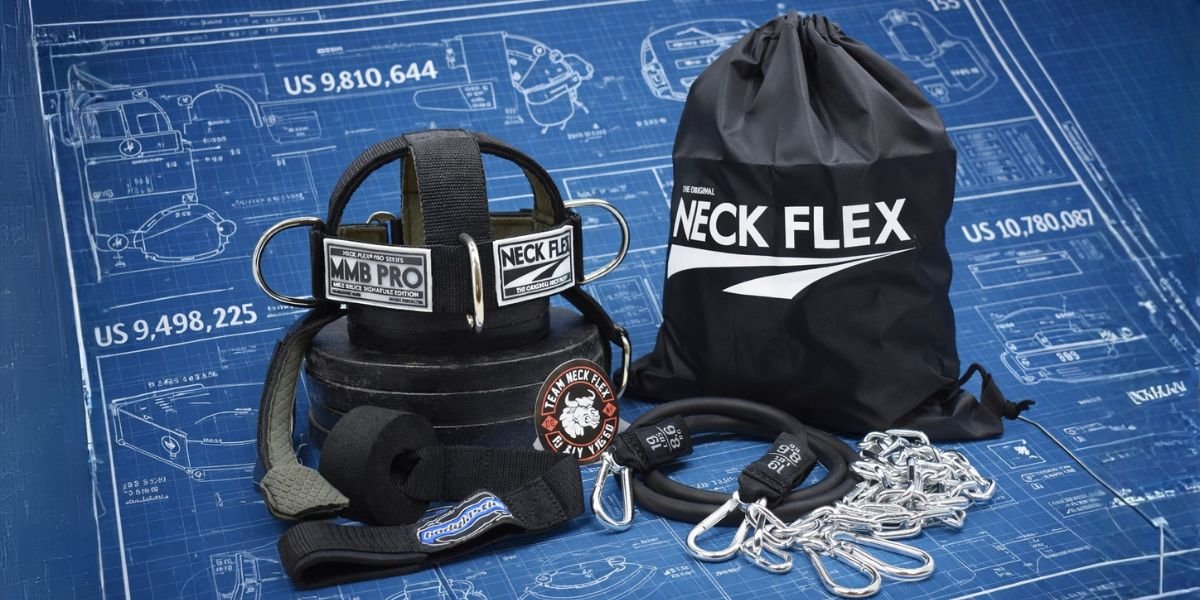
According to the company’s published development history, the design process extended over approximately two years and involved the construction of nine complete prototypes before a commercially viable product was finalized. Early concepts reportedly incorporated improvised equipment configurations and hand-sewn harness assemblies. The resulting system, introduced commercially in 2012, employed resistance bands attached to a head harness through multiple attachment points positioned around the circumference of the device. This arrangement permitted resistance to be applied from different angles while maintaining portability, an attribute that distinguished the system from many traditional cervical exercise devices available at the time.
The engineering concepts underlying the original Neck Flex system subsequently became the subject of several United States utility patents awarded to Gonza LLC. The first and most widely discussed of these patents, U.S. Patent No. 11,007,405 B2, issued in May 2021, covers a neck exercise device and system utilizing a head harness with multiple attachment members arranged to facilitate multidirectional resistance training. The patent documentation describes the limitations of conventional chain-based neck harnesses, which typically rely on two attachment points and offer comparatively limited movement configurations. The patented design incorporates multiple vertically oriented attachment members positioned around the head harness to enable resistance application during flexion, extension, lateral movement, and rotational exercises.
Additional patents expanded upon this initial framework. U.S. Patent No. 11,413,491 B2 addressed structural stabilization systems intended to improve dynamic cervical training. U.S. Patent No. 11,638,850 B2 covered universal attachment interfaces designed to accommodate resistance bands, cables, and chains. U.S. Patent No. 11,638,851 B2 focused on ergonomic load distribution and comfort features, while U.S. Patent No. 12,029,936 B2 addressed advanced load-management systems applicable to both athletic and rehabilitative settings. Collectively, these patents reflect an engineering strategy centered on modularity, multidirectional resistance application, and adaptability across multiple training environments.
The emergence of patented cervical training systems coincided with broader developments in sports science and rehabilitation research. A systematic review published in Archives of Physical Medicine and Rehabilitation in 2021 identified growing interest in standardized methods for evaluating cervical muscle strength and endurance. Similarly, rehabilitation researchers have increasingly examined the role of cervical exercise interventions in treating chronic neck pain, cervical dysfunction, and persistent post-concussion symptoms. Although no consensus currently exists regarding optimal cervical training protocols across all populations, scientific literature continues to support the importance of measurable and reproducible approaches to neck-strength assessment and training.
Neck Flex’s product development strategy appears to have reflected this emphasis on adaptability and application-specific training. The company’s HALO Series retained the multidirectional resistance architecture of the original system while incorporating heavy-duty nylon webbing and metal attachment hardware. Subsequent product lines, including the Ballistic Kevlar Series and the MMB Pro Series, developed in collaboration with Mike Bruce, introduced alternative construction materials, additional resistance modalities, and modified loading configurations. The company’s Revolver Rotation Attachment further expanded the system’s capabilities by introducing rotational resistance through a steel-braided cable mechanism designed to facilitate continuous movement patterns.
The company’s engineering and intellectual property strategy later attracted national attention through federal patent litigation involving competing cervical training products. In 2021, Gonza LLC filed a lawsuit against Mission Competition Fitness Equipment LLC in the Western District of Texas, alleging infringement of U.S. Patent No. 11,007,405. In December of that year, United States District Judge Alan Albright granted Gonza a preliminary injunction after finding that the company was likely to succeed on its infringement claim. Legal commentators noted at the time that preliminary injunctions of this kind are uncommon in patent litigation. The parties later resolved their dispute, and the litigation between the two companies concluded without a final ruling on the merits, with the last of the related cases dismissed by stipulation in March 2024.
More than ten years since its founding, Neck Flex is still one of the companies existing at the crossroads of sports performance, rehabilitation science, and engineering of exercise equipment that attracts more and more researchers’ attention. With new studies of cervical biomechanics, injury prevention, rehabilitation procedures, and athletic conditioning being constantly conducted, Neck Flex becomes a notable example of efforts by specialized equipment manufacturers to respond to emerging scientific interest.
Disclaimer: This article is for general informational purposes only and does not constitute medical, rehabilitation, fitness, or legal advice. Cervical exercises and resistance-training equipment may not be appropriate for everyone. Individuals with neck pain, previous injuries, neurological symptoms, or other medical conditions should consult a qualified healthcare professional before beginning a neck-strengthening program. References to patents and legal proceedings are based on publicly available records and should not be interpreted as legal conclusions or endorsements. Individual experiences and training outcomes may vary.