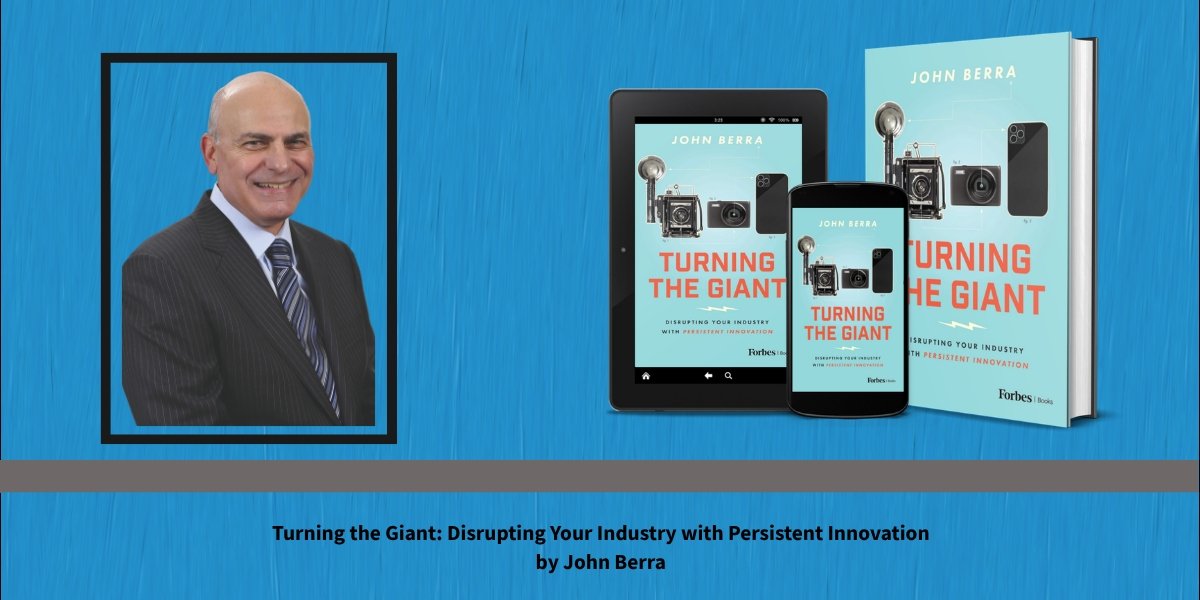
Business language is full of combat metaphors. Crush the competition. Slay the obstacle. Dominate the market. John Berra, the former Chairman of Emerson Process Management, spent decades inside one of the demanding corners of industrial business, and he came away with a noticeably different vocabulary.
His word is “turn.” Not defeat. Turn.
It’s the central idea behind his book Turning the Giant, and it’s a small linguistic shift that ends up changing quite a lot about how leaders approach the obstacles in their way.
Why “Slaying” Doesn’t Actually Work
John’s argument starts with a simple observation. Many of the major challenges leaders face, such as bureaucracy, skepticism, self-doubt, and competition, don’t go away just because you fight them hard enough. They’re persistent by nature. You can win a battle against them, and they’ll still be there next quarter, in a slightly different form.
What he learned instead is that these challenges have to be managed, redirected, and ultimately turned into something useful. That’s the entire philosophy packed into the book’s title. You don’t beat a giant. You turn it, and then it’s working in a different direction than it was before.
A Repetitive Job Started All of This
It’s worth knowing where John’s thinking actually came from, because it’s not a boardroom story. It’s a wire story.
Early in his career at Monsanto, he spent his days doing repetitive engineering work. Nothing glamorous. Just the same task, over and over, with plenty of time to think. And the thought that kept returning was: there has to be a better way.
That frustration didn’t evaporate. It became fuel. John describes properly channeled frustration as one of the powerful catalysts for innovation available to anyone, and his own career is the proof of concept.
The Bigger the Org, the Bigger the Giant
As John moved into senior roles, first at Fisher-Rosemount Systems and later at Emerson, he expected the obstacles to get easier to deal with. They didn’t. They got bigger.
Larger organizations come with more entrenched processes, more layers of skepticism, and more people whose default setting is “that’s not how we do things here.” What John learned in that environment is that transformation happens through accumulation, not force. One conversation at a time. One skeptic turned into an ally at a time. A long-term vision held steady even when the immediate response is resistance.
Doubt Is Part of the Job, Not a Disqualifier
John doesn’t pretend that any of this came easily or that he felt certain the whole way through. Quite the opposite. He’s candid that self-doubt showed up at nearly every major step forward in his career, especially when he was moving into responsibilities he hadn’t held before.
He frames it simply: growth and doubt travel together. If a leader is waiting to feel fully confident before taking on something new, they may be waiting indefinitely. The doubt isn’t a sign to stop. It’s often a sign that something worth doing is actually happening.
The One Question Worth Asking
If John could leave readers with a single habit, it would be a question to ask whenever resistance shows up: ” How can I turn this giant?
Not how do I defeat it? Not how do I avoid it? How do I turn it so that the same force working against you starts working, even partially, in your favor?
It’s a small shift in framing. But according to someone who spent a career doing exactly that, it’s the shift that makes everything else possible.
Berra develops the idea further in Turning the Giant, tracing how it took shape across a career spent turning obstacles in industrial automation into openings.