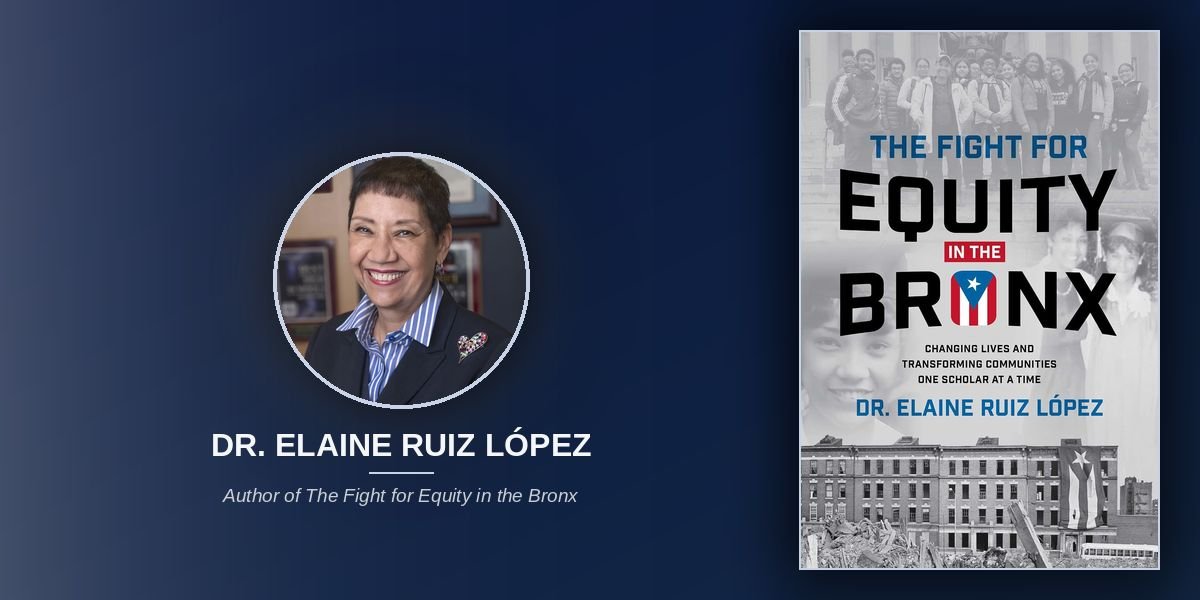
By: Kristine Kennedy
Leadership narratives tend toward a specific and satisfying shape. One visionary person sees what others don’t, fights through resistance that would have stopped most people, and builds something that simply wouldn’t have existed without their particular combination of insight, determination, and refusal to quit. The shape is compelling, and it is often partially true. It is also, when applied uncritically, a distortion that makes change seem more dependent on exceptional individuals and less dependent on the communities that make exceptional individuals possible.
Dr. Elaine Ruíz López pushes back against that distortion when it is applied to her own story, and she does so with unusual consistency and conviction. The school was never the accomplishment of one person. She says this plainly and returns to it throughout the book because the story is only fully true, and only fully useful to others who are fighting similar battles, when the whole community is visible in it.
The Fight for Equity in the Bronx: Changing Lives and Transforming Communities One Scholar at a Time honors the collective struggle because the story of International Leadership is ultimately a story about what becomes possible when a community refuses to accept what it has been told is good enough. That community includes parents who believed their children had a right to rigorous education in their own neighborhood and who showed up to demand it when institutions said no. Students who chose the school and committed to it before its future was secured. Educators who joined a fight rather than simply taking a job. Community advocates who added their voices at moments when the opposition seemed overwhelming, and the outcome seemed uncertain.
Social Capital Against Political Capital
One of the most significant and hard-won moments in the school’s founding was when its social capital proved stronger than its opponents’ political capital. That victory was not inevitable, was not guaranteed, and was contested every step of the way. But it happened. And it demonstrated something important about where power actually lives in communities that are frequently told they don’t have any.
Parents and students were not passive participants in the fight to establish International Leadership. They were the fight. Their presence, their voices, their willingness to keep showing up even when institutional resistance seemed insurmountable, created the conditions under which the school became possible. Dr. Elaine’s determination was essential to the outcome. So was theirs. And the book is explicit about this because the lessons of International Leadership’s founding are only fully visible when the whole story is told rather than the version that centers one heroic figure.
What Community Advocacy Actually Requires
Dr. Elaine wants South Bronx parents to understand something specific from her story. Their children’s circumstances do not determine their potential. She knows what it feels like to have an educational system essentially dismiss you, to be in circumstances that cause institutions to make assumptions about what you are capable of and what you deserve. She also knows that there can always be another chapter and that children deserve adults who see possibility in them, advocate for them, and refuse to allow institutions to define what they can become.
That advocacy is not comfortable or passive. It requires persistence against resistance from institutions that have more structural power and more resources. It requires the willingness to keep showing up even when the answer keeps being no. It requires the belief, in the face of evidence that can feel overwhelming, that the fight is worth continuing and that what is being demanded is right regardless of how long it takes to win.
International Leadership exists because enough people held that belief long enough and persistently enough to win. The book exists to make sure that the full story of how they did it is told, because other communities fighting the same battles deserve to know that it is possible.
The full story of what a community built when it decided its children deserved something better. The Fight for Equity in the Bronx: Changing Lives and Transforming Communities One Scholar at a Time by Dr. Elaine Ruíz López is available now on Amazon.