By: Audrey Denise B. Cachuela
Ask a nine-year-old to solve a word problem and watch the pencil stop moving, like there’s a trick buried in the sentence. Fast-forward twenty years. Hand that same person a lease to sign and a job offer with three competing pay structures, and they stall the same way. Same hesitation, older paperwork.
Spirit of Math has built its classrooms around that specific hesitation for more than thirty years. Kim Langen, the company’s CEO and co-founder, structured the program around a simple bet: a kid who learns to approach something unfamiliar ends up further ahead, long after graduation, than a kid who just memorized more formulas.
Say “math education” to most people, and they picture grades, formulas, the dread of a timed quiz. Mathematical thinking is the reasoning underneath the numbers, and it has almost nothing to do with sitting at a desk doing computation. It’s what lets someone compare two job offers with different benefits packages, guess honestly at how long a renovation will take, or catch a headline statistic that doesn’t mean what it claims to mean.
What Mathematical Thinking Actually Looks Like in Everyday Life
A budget looks like arithmetic until you actually build one. Most of the work happens before a single number gets added up: figuring out what’s a need versus a want you’ve talked yourself into, noticing the cost that quietly drains an account every month, leaving slack for whatever goes wrong. Deciding what to measure is harder than doing the math itself.
Something breaks, and nobody knows why, and that’s a different kind of problem. A laptop glitches, a car won’t start, a recipe comes out wrong for reasons nobody can name, and the process is always the same: isolate one variable, change it, see what happens, rule out what didn’t work. Nobody calls that math, but it’s the identical move a student makes tracing back through a proof to find where it went wrong. The same instinct applies when a headline statistic gets quoted without a sample size attached: the useful question is what the number is actually built on. The OECD defines mathematical literacy along these lines, as the capacity to reason with numbers and apply that reasoning to real judgment calls in personal, civic, and professional life (Source: PISA Mathematics Framework, 2023).
Why the Reasoning Outlasts the Formula
Ask an adult to recite the quadratic formula and most will draw a blank. That’s fine, because the formula was never the point. What sticks is knowing which kind of question you’re facing before reaching for any tool, and that judgment doesn’t expire the way a formula does.
A student who only learned to copy a method freezes when the wording changes or the setup looks unfamiliar. Someone who understands why the method works has more options: hunting for a similar problem solved before, isolating what’s missing, shrinking the problem down to something manageable. That same move shows up later, breaking down a dense paragraph in a history essay or tracking a bug through a hundred lines of code.
Checking your own answer matters just as much as finding one. A restaurant bill of six thousand dollars for a table of four should raise an eyebrow immediately, and so should a delivery estimate of three minutes for a cross-country package. Catching that kind of error in your own work eventually stops feeling like an extra step and becomes automatic.
Breaking Problems Down Becomes a Habit
A big problem feels impossible before anyone’s started, usually because too many questions are competing for attention at once. Picture a kid working through a dense word problem: write down what’s known, name what’s missing, pick one manageable step, and let whatever comes out of it feed the next one. If the approach falls apart somewhere along the way, there’s still enough structure left to find exactly where, instead of scrapping everything and starting over.
The same sequence gets a teenager through a major assignment, minus most of the crying. “Finish the project” turns into stages, each with its own rough deadline, which also makes starting less painful: a single enormous task invites procrastination just by existing, while a staged version invites action because the first step is small enough to actually attempt. Years later, that identical process resurfaces at work, planning an event or managing a team that’s fallen behind. The Education Endowment Foundation frames this kind of metacognitive strategy as helping students plan, monitor, and evaluate their own learning while they work, and finds it lands best when teachers build it into subject lessons rather than treating it as a separate add-on (Source: Metacognition and Self-Regulated Learning, 2025).
Teaching Math So the Thinking Actually Sticks
Fluency and understanding train different things. Showing a student a procedure once and handing them a worksheet of near-identical problems builds speed at copying it. Real understanding comes from deciding when a piece of knowledge applies and why, which is a judgment call, not a memory exercise. Asking “How do you know?” instead of “What’s the answer?” forces a student to lay out their reasoning in an order someone else can follow, and when a classmate lands on a different answer, both students end up tracing back to find exactly where their thinking diverged. An Ofsted subject report draws a similar line, separating practice that builds speed and accuracy from the more exploratory work of explaining relationships and reasoning, and concludes classrooms need both (Source: Coordinating Mathematical Success: The Mathematics Subject Report, 2023).
Inside the Classroom: How This Plays Out at Scale
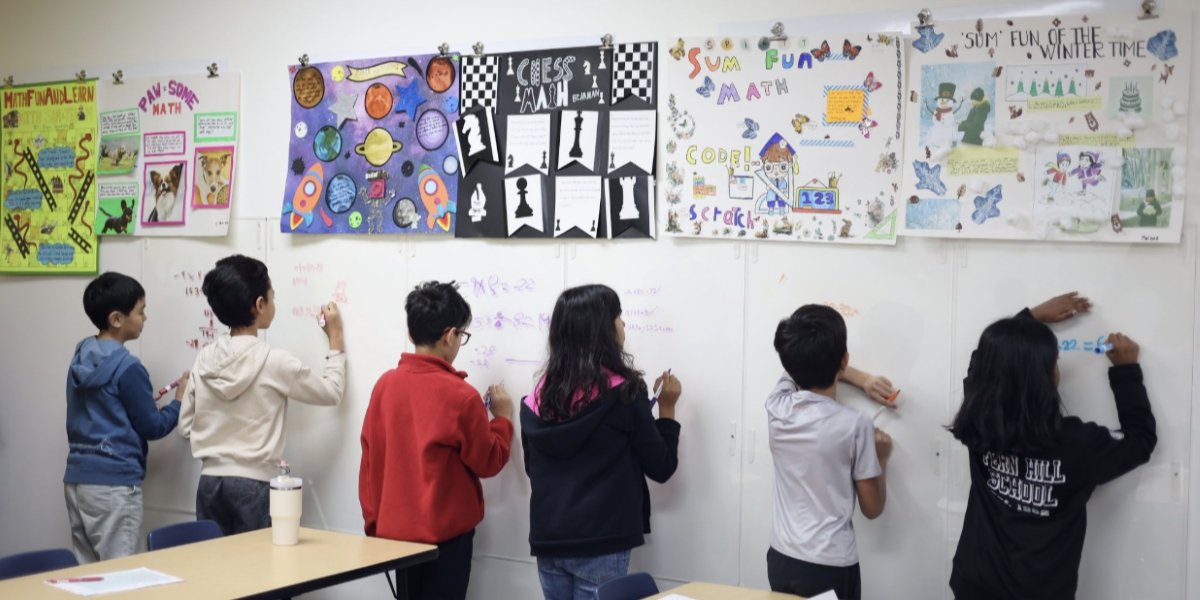
Walk into a Spirit of Math classroom, and this premise stops being abstract. Students spend their time interpreting a question, testing approaches, and putting their reasoning into words someone else can follow, with the right answer as only part of what’s happening in the room. The program layers core curriculum, drills, problem solving, and group work together, and teachers complete more than one hundred hours of training before they ever work with a student. Close to nine hundred Spirit of Math students landed placements on national mathematics honour rolls in one recent year, across 35+ campuses.
No school can hand a kid a pre-written answer for every situation waiting for them down the road. A strong math education gives them a reliable way to approach whatever question nobody saw coming, whether it shows up on a test, inside a budget, or in a decision that has nothing to do with numbers at all.
If you want your child building that kind of reasoning well past worksheets and test scores, Spirit of Math offers placement interviews to help find the right in-person or online program, one that gives kids regular practice solving, explaining, and defending problems that are genuinely difficult.